
The Great Attractor: The Invisible Pull of the Cosmic Abyss
This article delves into the enigma of the Great Attractor, exploring the immense gravitational force that shapes our cosmic destiny.
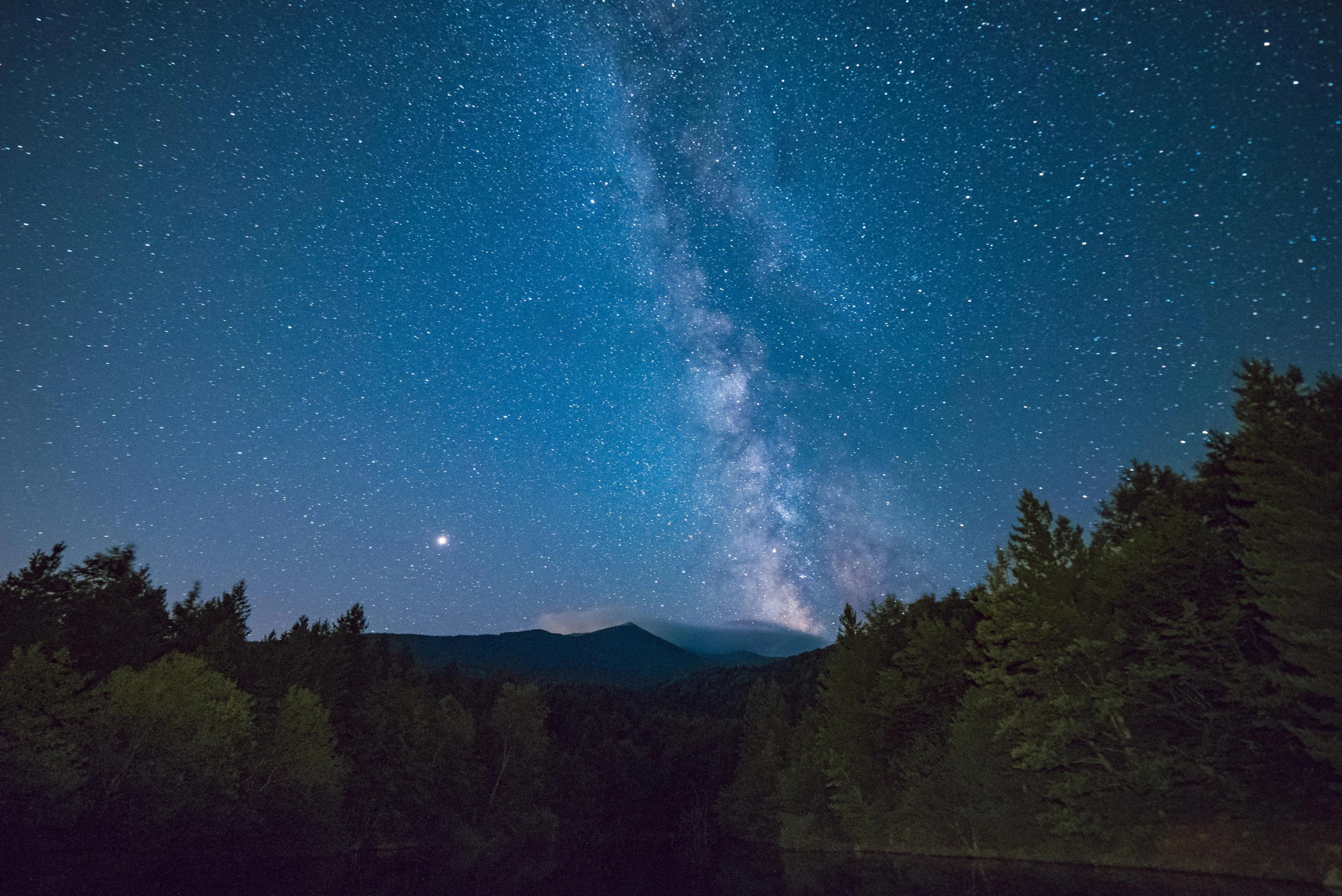
Our night sky, even viewed with the naked eye, is filled with the countless stars that constitute our Milky Way galaxy. For centuries, humanity has gazed upon these stars, attempting to understand its place in the universe. In the 20th century, thanks to a technological leap, we discovered that our galaxy is merely one among billions, perhaps even trillions, of others. Yet, within this seemingly infinite cosmic dance, there is a motion that for decades has remained one of science's greatest mysteries. Our galaxy, along with its neighbor Andromeda and the other galaxies of our Local Group, is hurtling at an incredible speed—approximately 600 kilometers per second (2.2 million kilometers per hour)—toward a specific, invisible point in space. This point, hidden behind the dust and stars of our own galaxy, bears a name that sounds like the title of a science fiction novel: The Great Attractor.
What is this mysterious force? How can an entire galactic cluster, containing the mass of trillions of stars, be pulled toward something we cannot even clearly see? The story of the Great Attractor is not just about astrophysical discoveries; it is about the very structure of the universe, the enigma of dark matter, and the fact that our cosmic neighborhood is far more complex and dynamic than we ever imagined.
The Discovery of the Cosmic Flow
The first suspicions about the existence of the Great Attractor arose in the 1970s. Astronomers studying the Cosmic Microwave Background (CMB), considered the "afterglow" of the Big Bang, noticed a strange anomaly. The CMB is almost perfectly uniform across the entire universe, a testament to the fact that the early universe was incredibly hot and dense. However, measurements showed that on one side of the sky, the CMB is slightly "hotter" (a blueshift), while on the opposite side, it is slightly "cooler" (a redshift). This is known as the dipole anisotropy.
In physics, this phenomenon is explained by the Doppler effect. When we move toward a source of light, the light waves are compressed, becoming shorter and bluer. When we move away, the waves are stretched, becoming longer and redder. The dipole anisotropy of the CMB had only one logical explanation: our Solar System, and with it the entire Milky Way galaxy, is moving. And it is moving very fast.
Initial calculations showed that our Local Group (which includes the Milky Way, Andromeda, and about 80 other smaller galaxies) is moving at about 600 km/s in the direction of the Hydra-Centaurus constellation. This speed is simply immense. To put it in perspective, if we could travel at that velocity, we would reach the Moon from Earth in about 11 minutes.
But what was causing this motion? The general expansion of the universe, known as the Hubble flow, explains why galaxies are mostly moving away from each other. However, this particular motion was "peculiar" - it was directed toward a specific point and exceeded the velocities expected at a local level. This meant that in addition to the general Hubble flow, another local gravitational force was at play, pulling our galaxy and its neighbors. The center of this invisible mass was dubbed "The Great Attractor."
The Zone of Avoidance: Behind the Cosmic Curtain
The study of the Great Attractor faced a formidable obstacle known as the "Zone of Avoidance." This is the region of the sky that lies along the plane of the Milky Way's disk. When we try to look in that direction, the interstellar dust, gas, and billions of stars of our own galaxy block visible light, creating a kind of cosmic "blind spot." Unfortunately, the Great Attractor is located right in the middle of this zone. We were trying to study one of the largest gravitational anomalies in the universe, but it was hidden behind the "pillars" of our own home.
To overcome this problem, astronomers began using other observation methods that could "see" through the dust. Radio telescopes and infrared telescopes can detect longer-wavelength radiation that is not absorbed by interstellar dust. Thanks to these technologies, in the 1980s and 1990s, a group of astronomers, including Alan Dressler and Sandra Faber, began to map the galaxies behind the Zone of Avoidance.
Their work revealed that in the suspected location of the Great Attractor, there exists a massive supercluster of galaxies known as the Norma Cluster. It is located about 220 million light-years from us. This cluster contains thousands of galaxies and has the mass of trillions of suns. At first, it seemed the mystery was solved: the Norma Cluster was the powerful gravitational center pulling us in.
However, it soon became clear that the story was far more complicated. When scientists calculated the visible mass of the Norma Cluster (stars, gas), it turned out to be insufficient to explain our galaxy's 600 km/s velocity. Its gravitational pull could only account for a fraction of that motion. This meant that the Great Attractor was not simply the Norma Cluster, but a much larger, more massive, and possibly more diffuse structure.
Laniakea: Our Cosmic Address
At the beginning of the 21st century, technological advancements allowed for more precise mapping of galactic movements. In 2014, a team led by astrophysicist R. Brent Tully introduced a new concept that completely changed our understanding of cosmic structures. They studied the motion vectors of more than 8,000 galaxies and discovered that our Milky Way is not only moving toward the Great Attractor but is also part of an unimaginably vast structure they named Laniakea.
Translated from Hawaiian, "Laniakea" means "immeasurable heaven." It is a supercluster of galaxies that includes about 100,000 galaxies, including our Local Group, the Virgo Cluster, and many other structures. Laniakea stretches over 520 million light-years. According to this new model, the Great Attractor, with the Norma Cluster at its heart, serves as the gravitational center or, in other words, the lowest point of the "valley" of Laniakea. All galaxies within the boundaries of Laniakea, including us, are "flowing" toward this common center, much like raindrops flowing toward the lowest point of a watershed basin.
Thus, our motion is not merely the result of being pulled toward a single object but is part of a vast cosmic current that shapes the structure of our supercluster. We live in one of the outer arms of Laniakea and, like the other 100,000 galaxies, we are slowly moving toward its gravitational heart.
The Shapley Supercluster and the Enigma of Dark Flow
However, even the discovery of Laniakea did not definitively solve the mystery. It turned out that behind the Great Attractor, about 600 million light-years away, there exists another, even more massive structure: the Shapley Supercluster. This is the most dense and massive supercluster in the observable universe. It contains tens of thousands of galaxies and has a mass equivalent to more than 10,000 Milky Way galaxies.
Today, scientists believe that our galaxy's motion is the result of two main forces: the pull of the nearby Great Attractor and the pull of the more distant but vastly more powerful Shapley Supercluster. The Great Attractor acts as a local "hill" that pulls us, while Shapley is a colossal "mountain range" toward which we are ultimately heading. Laniakea itself, as a whole, is being pulled toward the Shapley Supercluster.
But here arises another, even deeper mystery: the dark flow. Some astronomers, studying the movements of distant galaxy clusters, claim to have observed a unified, coherent motion toward a specific point in the sky that lies beyond the boundaries of the observable universe. This hypothetical motion cannot be explained by the gravity of either the Great Attractor or the Shapley Supercluster. If the existence of dark flow is confirmed, it would mean that our observable universe is being influenced by a gravitational force whose source lies beyond the cosmic horizon. It could be another, unimaginably massive cosmic structure or even the gravitational influence of another universe within the framework of multiverse theory. This idea is highly controversial, and many scientists consider it a result of statistical error, but it remains one of the most mystical puzzles of the cosmos.
The Mysticism and Philosophy: What Lies in the Abyss?
The scientific explanations for the Great Attractor and its related phenomena are as impressive as they are provocative, raising questions that transcend the boundaries of pure physics. The idea of this vast, invisible structure pulling trillions of stars touches upon the deepest fears and curiosities of the human subconscious.
- The Allure of the Unknown: In human culture, the "abyss" has always been a symbol of the unknown, the dangerous, and yet, the enticing. The Great Attractor is an abyss on a cosmic scale. We are moving toward something we cannot fully see or comprehend. What lies there, at the center of that incredibly dense cluster of galaxies? Perhaps black holes with masses billions of times greater than our Sun. Perhaps the laws of physics as we know them operate differently there.
- The Question of Fate and Free Will: Our galaxy's journey toward the Great Attractor is inescapable. It is a cosmic destiny written in the laws of gravity. We, as humanity, along with our planet and our star, are merely passengers on this enormous spaceship moving in a predetermined direction. This forces us to contemplate our place and significance in this grand cosmic dance. Do we have any control over our ultimate destination, or are we simply subject to cosmic forces immensely more powerful than ourselves?
- The Role of Dark Matter and Dark Energy: The majority of the Great Attractor's mass, like ~85% of the rest of the universe's mass, is composed of dark matter. This is a mysterious substance that does not interact with light, and we know of its existence only through its gravitational effects. The Great Attractor is one of the most massive and impressive manifestations of dark matter. It reminds us that the overwhelming majority of the universe is invisible and inaccessible to us. We live in a world whose true nature is hidden from our senses.
Future Prospects: What Awaits Us?
What awaits our galaxy at the end of this long journey? Ultimately, over billions of years, the galaxies of Laniakea, including the Milky Way, will continue to approach the center of the supercluster. Along the way, the Milky Way will collide and merge with the Andromeda galaxy, forming a new, larger galaxy that scientists have provisionally named "Milkomeda."
This new galaxy will continue its journey toward the center of the Great Attractor. However, before we can reach it, another, even more powerful cosmic force will come into play: dark energy. This is the force responsible for the accelerated expansion of the universe. Today, dark energy is causing superclusters of galaxies to move away from each other. Scientists believe the influence of dark energy will intensify over time.
This means that although gravity still dominates within Laniakea, causing galaxies to draw closer, on the scale of superclusters, dark energy will win. It is possible that our supercluster will never reach the Shapley Supercluster because the space between them will expand faster than they can approach each other. Moreover, according to some theories, in the distant future, dark energy could even "tear apart" galaxies, star systems, and even atoms (the "Big Rip" scenario).
Thus, we find ourselves at the epicenter of a struggle between two powerful cosmic forces: gravity and dark energy. On one hand, the gravity of the Great Attractor pulls us toward unity, toward the center of a vast cosmic structure. On the other hand, dark energy pushes us toward isolation, toward a cold and empty future where galaxies will be infinitely far from one another.
The mystery of the Great Attractor remains a reminder of how little we know about our cosmic home. It symbolizes science's relentless quest to shed light on the deepest darkness, even when that darkness is shrouded behind the curtain of our own galaxy. We continue our journey toward that invisible point, being both observers and participants in a cosmic drama whose final act has yet to be written.
Related articles

 SpaceSeptember 8, 2025
Secrets of the Airplane's "Black Box": What It Really Is and How It Saves Lives
7 min read TechnologyAugust 26, 2025
The Paradox of the Future: Why We Fear the Next 100 Years
3 min read SpaceAugust 26, 2025
Cosmic Forges: The Role of Supernova Explosions in Cosmic and Human Evolution
3 min read SpaceAugust 26, 2025
The Era of Space Junk: Humanity's Invisible Pollution
3 min read SpaceAugust 25, 2025
Mars's Aqueous Past: The Invaluable Discovery of the Curiosity Rover
2 min read HistoryAugust 21, 2025