
Dark Matter and Dark Energy: The Invisible Side of the Universe
The universe we see is full of stars, planets, galaxies, and billions of luminous objects. We might think we know what it's made of, but in reality, everything visible to us constitutes only about 5% of the total matter and energy in the universe.
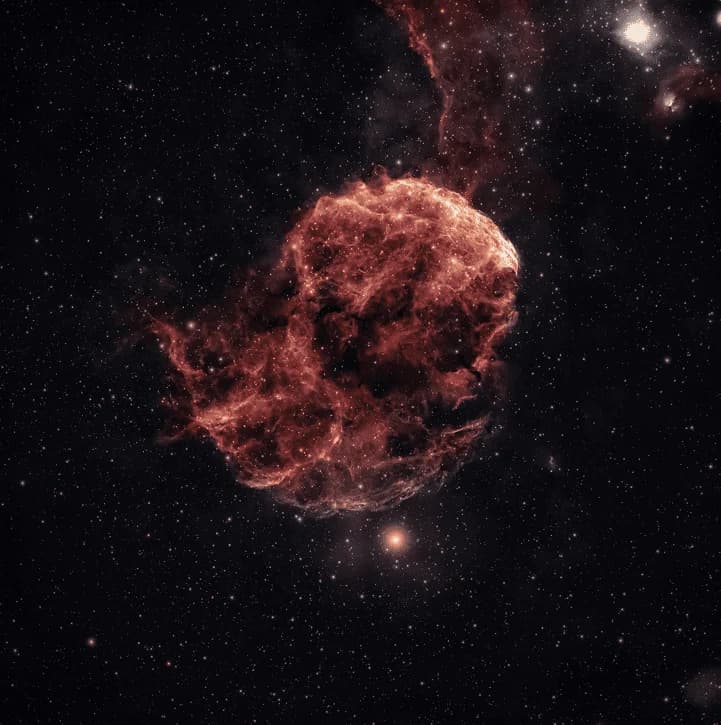
The remaining 95% is dark and invisible, composed of dark matter and dark energy. These two mysterious phenomena are not only the universe's greatest secrets but also the primary driving forces behind its formation and its ultimate fate.
Dark Matter: The Cosmic Glue
Dark matter is a type of matter that does not emit, absorb, or reflect light, which makes it impossible to observe directly with any telescope. We can only infer its existence through its gravitational effects. This concept was first proposed in the 1930s by Fritz Zwicky, who was studying the Coma Cluster of galaxies. He noticed that the galaxies were moving at such high speeds that they should have long since scattered into space if the cluster's entire mass was composed only of visible stars. This indicated that the cluster must contain a much larger amount of invisible mass.
Later, in the 1970s, Vera Rubin confirmed Zwicky's findings by studying the rotation speed of galaxies. She discovered that stars on the outer edges of galaxies were rotating at nearly the same speed as those closer to the center. This defied all known laws of physics. Logically, the outer stars should have rotated more slowly, but they were moving fast, as if orbiting a gigantic, invisible "halo" made of dark matter. It is this dark matter that provides the extra gravitational pull needed to hold galaxies and their clusters together. It acts as a cosmic "scaffolding" upon which visible galaxies are formed.
Dark Energy: The Universe's Secret Engine
If dark matter explains the gravitational forces within the universe, dark energy explains the universe's overall behavior. In 1998, two independent teams of astronomers, led by Saul Perlmutter, Brian Schmidt, and Adam Riess, made a revolutionary discovery that later earned them a Nobel Prize. They were studying distant supernova explosions to measure the expansion rate of the universe. They expected that gravity would cause the expansion to slow down, but they found the opposite: the universe was expanding at an accelerating rate.
This unexpected result suggested that an unknown force, dark energy, was counteracting gravity and pushing galaxies apart. Dark energy acts as a kind of "anti-gravity" that is causing space to expand faster and faster. Just like with dark matter, we cannot see dark energy directly, but its effects are observable everywhere.
Scientific Pursuits and Future Prospects
Understanding the nature of dark matter and dark energy is one of the biggest challenges in modern physics and astronomy. Scientists are working in various directions to unravel these mysteries.
- Dark Matter. Deep underground laboratories have been built on Earth where hypersensitive detectors are searching for dark matter particles. These experiments aim to find particles such as WIMPs (Weakly Interacting Massive Particles) or axions.
- Dark Energy. Massive space telescopes, such as the James Webb and the upcoming Euclid, are meticulously mapping distant galaxies and their clusters to study the history of the universe's expansion and thereby unlock the secret of dark energy.
Dark matter and dark energy force us to re-evaluate the fundamental laws of physics and question whether we have correctly understood the universe's structure. Solving these mysteries could not only revolutionize physics but also provide invaluable information about how the universe was created and what its ultimate fate will be.
Related articles
 SpaceOctober 13, 2025
The Great Attractor: The Invisible Pull of the Cosmic Abyss
14 min read SpaceSeptember 8, 2025
Secrets of the Airplane's "Black Box": What It Really Is and How It Saves Lives
7 min read TechnologyAugust 26, 2025
The Paradox of the Future: Why We Fear the Next 100 Years
3 min read SpaceAugust 26, 2025
Cosmic Forges: The Role of Supernova Explosions in Cosmic and Human Evolution
3 min read SpaceAugust 26, 2025
The Era of Space Junk: Humanity's Invisible Pollution
3 min read SpaceAugust 25, 2025