
“Wedding in the Mountains”: The Liberation of Shushi
May 9 is remembered not only as a battlefield triumph, but as a symbol of human stories and sacrifice – when young volunteers and seasoned commanders together liberated Shushi.
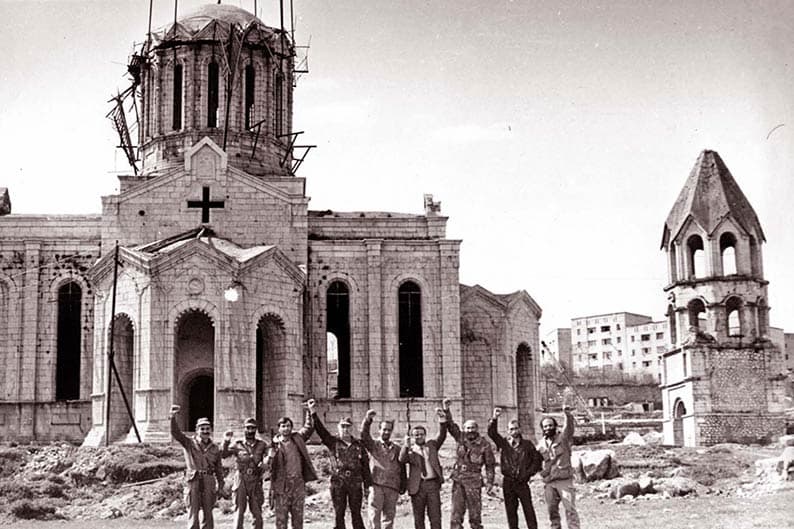
In the spring of 1992, Artsakh stood on the edge of destruction. Stepanakert and nearby villages were under constant bombardment from Shushi - a strategic city perched high on the cliffs, serving as a major Azerbaijani stronghold. Civilians were dying daily, homes were being destroyed, and people were living in shelters for months.
In this desperate situation, the Armenian leadership and volunteer units decided to take a decisive step: to liberate Shushi. The operation was given the symbolic code name “Wedding in the Mountains.” The name was partly for secrecy, but it also symbolized a new beginning - just as a wedding is the start of a new life, liberating Shushi would mark a new chapter for Artsakh.
Preparation
Shushi was considered a natural fortress - located on steep mountains, overlooking Stepanakert entirely.
- The Azerbaijani side had about 2,500 soldiers, with artillery and heavy weaponry.
- The Armenian forces numbered about 1,200–1,500 fighters, mostly volunteers. They had almost no heavy equipment.
The plan of the operation was developed by Armenian commanders:
- Arkadi Ter-Tadevosyan (Komandos) – the main commander of the operation,
- Gurgen Dalibaltayan,
- Samvel Babayan,
- Seyran Ohanyan,
- and other unit commanders.
Komandos later recalled:
“From a military point of view, we were not ready… but there was no other way. We had to liberate Shushi.”
Vazgen Sargsyan’s Role
The code name of the operation is directly tied to Vazgen Sargsyan. At that time, he was a member of Armenia’s Defense Committee and later became the Minister of Defense.
Arkadi Ter-Tadevosyan recalled:
“I promised Vazgen Sargsyan that if we liberated Shushi, we would hold his wedding in the mountains. That is how the operation got the name ‘Wedding in the Mountains.’”
Vazgen Sargsyan inspired both soldiers and people with his words:
“Victory is born not from weapons, but from will. When the people and the army are united, no force can defeat us.”
The Course of the Operation
The attack began during the night of May 8 to May 9, 1992, at around 2:30 a.m.
- Armenian units launched simultaneous attacks from several directions – Dashalti, Karin Tak, and the southern approaches.
- Street fighting began, with fighters clearing Shushi house by house.
- The Azerbaijani defenders were caught off guard by the multi-directional assault.
By the morning of May 9, Shushi was liberated.
Komandos later said:
“When I declared that there were no enemy troops in the city, I simply sat down and fell asleep… I hadn’t slept for days. That’s how I entered liberated Shushi – asleep.”
Human Stories
The liberation of Shushi was not only a military victory, but also a day of deeply human stories:
- Many fighters went into battle while their families were hiding in shelters in Stepanakert.
- Some volunteers left their weddings or family celebrations to join the fight.
- Among the fallen was Aleksan Harutyunyan, who advanced with his unit on one of the hardest directions and gave his life on the day of victory.
- In Stepanakert, people wept with joy when the news broke: “When they said on the radio that Shushi was ours, we hugged each other and believed we had been saved.”
Casualties and Losses
- The Armenian side suffered about 60-70 killed and more than 250 wounded.
- Azerbaijani losses are estimated at 200-300 killed, around 300 wounded, and dozens captured.
- The casualty ratio showed how determined the Armenian fighters were and how effective the operation had been.
Aftermath
The liberation of Shushi became the turning point of the First Nagorno-Karabakh War. It ended the shelling of Stepanakert and opened the way to the Lachin Corridor, linking Artsakh directly with Armenia.
May 9 became a triple holiday:
- Victory in the Great Patriotic War,
- The Liberation of Shushi,
- The establishment of the Defense Army of Artsakh.
“Wedding in the Mountains” was not just a code name. It symbolized faith, unity, and sacrifice. The liberation of Shushi proved that even against a numerically and technically superior force, victory is possible when there is will and determination.
Today, we remember those days not only as a military triumph, but also as a collection of human stories - of young men who opened the road to freedom with their lives.
Related articles
 HistoryJanuary 7, 2026
Iran: From a Millennial Empire to the Strict Mandates of the Islamic Republic
5 min read HistoryJanuary 7, 2026
Venezuela: The Tragic Phoenix of Latin America - From Oil Paradise to Geopolitical Nightmare
6 min read LifestyleDecember 9, 2025
Festive Tables Around the World: New Year's Traditions and Their Flavorful Nuances
9 min read HistoryDecember 8, 2025
The Spitak Earthquake: History and Statistics of a Catastrophe (December 7, 1988)
7 min read HistoryNovember 17, 2025
The Horrifying but True Story of a 5-Year-Old Who Became a Mother
4 min read HistoryNovember 7, 2025