
Orpheus and Eurydice: The Love That Descended Into the Underworld
The story of Orpheus and Eurydice is one of Greek mythology’s most haunting tales - a love that defied death, a song that moved the gods, and a man who lost everything with one glance.
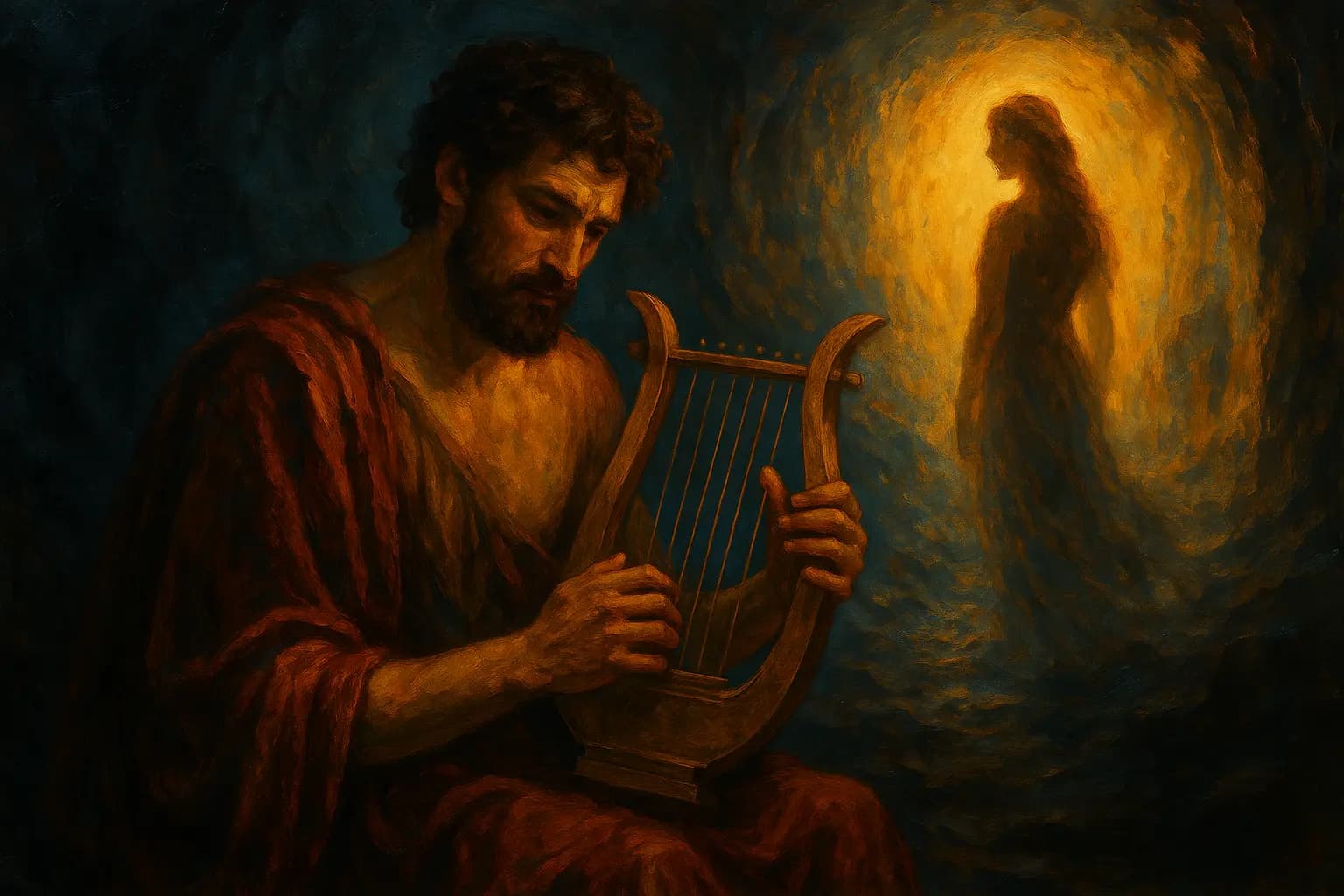
Among all Greek myths — filled with gods, heroes, and tragedies — few resonate as deeply as the story of Orpheus.
He wasn’t a warrior, nor a king, but a musician whose songs could tame beasts, move mountains, and soften even the hearts of gods.
And in the center of his legend stands a love so pure and devastating that it became immortal - the love of Orpheus and Eurydice.
The Musician the Gods Could Hear
Born in Thrace, Orpheus was said to be the son of Apollo, god of music and light. From him, he inherited not only the divine gift of melody but the sacred lyre, whose strings could mirror the human soul.
His music could charm animals, stop rivers from flowing, and bring peace to those tormented by grief. But his greatest power was not technical skill - it was emotion. Orpheus could translate love, loss, and longing into sound.
Eurydice - The Love That Changed Everything
When Orpheus met Eurydice, time seemed to stop. Their love was immediate, innocent, and infinite. But fate, cruel as ever, had other plans.
On the very day of their wedding, Eurydice was bitten by a serpent and died. The world fell silent for Orpheus.
Yet instead of surrendering to grief, he made a decision no mortal had dared before - to descend into the Underworldand bring back his beloved.
The Music That Moved the Dead
When Orpheus entered Hades, even the shadows paused. His lyre’s sound floated through the darkness, reaching the throne of Hades and Persephone themselves.
For the first time, the god and goddess of death were touched by mortal sorrow. Hades granted his wish: Eurydice could return to life.
But there was one rule - Orpheus must not look back at her until they both reached the surface.
The Moment Everything Fell Apart
They began their ascent, one step after another through the silent tunnels. Orpheus could hear her behind him, but he could not see her.
Doubt began to gnaw at his heart - what if she wasn’t really there? What if Hades had deceived him?
As they neared the light of the upper world, he couldn’t resist.
He turned.
And in that brief, fatal moment, Eurydice vanished once more — drawn back into the shadows forever.
The Music of Grief
Orpheus returned to the world of the living, but he no longer belonged to it. He wandered the earth alone, singing songs so sorrowful that nature itself wept.
He rejected all human affection, dedicating himself entirely to his art and to the memory of Eurydice.
Even after his death - torn apart by the frenzied Maenads - his head and lyre were said to continue singing her name, drifting over the Aegean Sea.
A Symbol Beyond Time
The story of Orpheus and Eurydice is not merely a tale of love and loss. It’s a mirror reflecting the human condition — our longing to reverse time, to defy fate, to bring back what is gone.
It is about how love drives us to the edge of the impossible, and how even failure can create beauty that lasts forever.
Modern Interpretation
Today, Orpheus can be seen as the archetype of the artist - one who descends into the darkness of his own soul to create light.
Eurydice, in turn, represents the unattainable ideal - the muse, the lost inspiration, the memory that keeps the artist alive and tormented all at once.
Their story endures not because it ends in tragedy, but because it reveals something eternal: that love and art are two sides of the same defiance against death.
Conclusion
The myth of Orpheus and Eurydice reminds us that
the deeper the love, the closer it lies to death -
and from that collision, true art is born.
Related articles

 HistoryJanuary 7, 2026
Iran: From a Millennial Empire to the Strict Mandates of the Islamic Republic
5 min read HistoryJanuary 7, 2026
Venezuela: The Tragic Phoenix of Latin America - From Oil Paradise to Geopolitical Nightmare
6 min read LifestyleDecember 9, 2025
Festive Tables Around the World: New Year's Traditions and Their Flavorful Nuances
9 min read HistoryDecember 8, 2025
The Spitak Earthquake: History and Statistics of a Catastrophe (December 7, 1988)
7 min read HistoryNovember 17, 2025
The Horrifying but True Story of a 5-Year-Old Who Became a Mother
4 min read HistoryNovember 3, 2025