
The Spitak Earthquake: History and Statistics of a Catastrophe (December 7, 1988)
The Spitak Earthquake, which struck on December 7, 1988, at 11:41 AM local time, became one of the greatest disasters in the modern history of Armenia. It shook the northern regions of Soviet Armenia at the time and had profound socio-economic and political consequences.
I. Geological and Seismic Characteristics
The earthquake occurred in the seismically active zone of the Lesser Caucasus, located in the collision boundary between the Arabian and Eurasian tectonic plates.
The official magnitude of the earthquake was estimated to be around Mw=6.8 (moment magnitude), and Ms=7.0(surface wave magnitude). This tremor corresponded to a considerably high amount of energy. The depth of the focus was extremely shallow, around 5-10 km, meaning that the majority of the energy directly impacted surface structures, greatly increasing the destruction.
As a result of the earthquake, the Spitak fault formed on the ground surface, estimated to be about 35-40 km long. The displacement was primarily of a reverse-fault nature, and vertical displacements of up to 2 meters were recorded. Thousands of aftershocks were recorded, the strongest of which occurred 11 minutes after the main earthquake, measuring approximately Mw=5.8.
II. Numerical Consequences of the Disaster
The disaster zone covered about 40% of Armenia's territory, where nearly one million people resided. The official figures illustrate the immense scale of the catastrophe.
Human Losses
The official figures for human losses demonstrate the extent of the disaster:
- The number of fatalities reached approximately 25,000 people.
- The number of injured reached about 19,000.
- The number of people hospitalized exceeded 15,000.
- More than half of the population in the disaster zone, over 514,000 people, were left homeless. The majority of the casualties (around 17,000 to 20,000) were concentrated in Leninakan (Gyumri), while in Spitak, about one-third of the city's population perished. A significant proportion of the victims were children and schoolchildren, as the disaster struck during class hours.
Material Destruction
The earthquake caused catastrophic material damage:
- About 17 million square meters of residential area were destroyed or damaged, accounting for roughly 20% of the republic's housing stock.
- More than 420 industrial enterprises ceased operation or were damaged.
- 419 schools and kindergartens, as well as 210 healthcare facilities, were damaged or completely collapsed.
- Over 250 cultural objects were damaged.
- Approximately 30 km of railway track and a number of power plants went out of order in the disaster zone.
The total material damage, according to official USSR data, was estimated at around $15 billion USD (in 1988 prices). Spitak, Leninakan, and Kirovakan (Vanadzor) were the cities hit hardest, where the degree of destruction exceeded 80%.
III. Causes of the Disaster and Construction Flaws
The unprecedented scale of human casualties and destruction was attributed not only to the natural force but also to man-made factors, particularly severe violations of construction standards.
- Violations of Construction Norms: The mass construction of panel and large-block residential buildings widely used in the USSR, including Armenia, was often carried out without proper adherence to seismic resistance requirements.
- Substandard Materials: Investigations revealed that low-quality concrete and weak mortar were widely used during the construction of many buildings, and the placement of reinforcing mesh was often flawed.
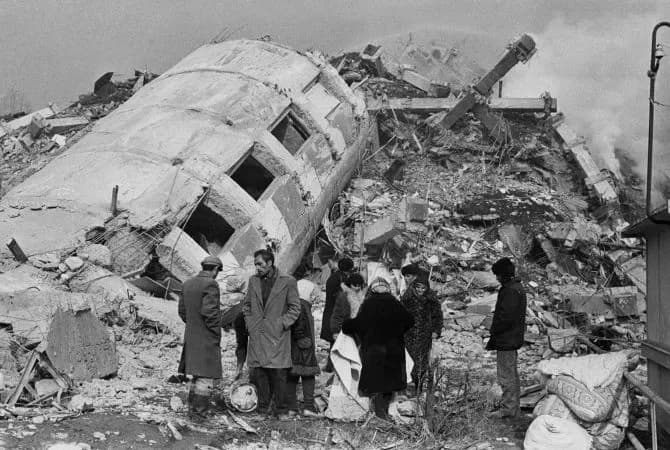
- Type of Building Collapse: The so-called "4th series" residential buildings, particularly in Leninakan, collapsed in a "pancake collapse" manner, where the floors fell flat on top of one another after the supporting columns and walls failed. This left almost no chance of survival for the occupants.
IV. Leninakan/Gyumri: The Epicenter of Tragedy
While the earthquake is named after Spitak, the greatest human casualties and material destruction were concentrated in Leninakan (now Gyumri). The city, which was the second largest settlement in Armenia, was located only about 40 km from the epicenter and was almost entirely devastated.
The Tragic Figures of Leninakan
Leninakan became the primary victim of the disaster, given its high population density and construction specificities.
- Human Losses: The number of fatalities in Leninakan accounted for the majority of the official 25,000 casualties—around 17,000 to 20,000 people. The city lost about 10% of its population in a single minute. This unprecedented casualty figure was particularly high among residents of multi-story panel buildings.
- Destroyed Housing Stock: Approximately 80% of the city’s residential fund was either completely destroyed or rendered unusable. The total area of destruction was around 10 million square meters.
- Infrastructure: Factories and industrial enterprises (which were a vital part of Armenia's economy) went out of commission. In particular, all school buildings and the largest hospitals in the city completely collapsed, severely complicating rescue efforts and aid to the injured.
V. International Response and the Long Era of Recovery
The Spitak Earthquake was an unprecedented display of international cooperation, as the USSR officially requested and accepted foreign aid for the first time in its history.
- Aid: 113 countries worldwide and dozens of international organizations provided aid, including about 2,000 rescuers from different countries.
- Financial and Material Aid: Billions of dollars in aid were allocated, along with large quantities of food, medicine, and construction materials.
- The Soviet Phase (1988–1991): Initially, the USSR government declared that the city would be rebuilt within 5 years. Significant funds were allocated, and construction work began, including the building of about 30,000 apartments. All Soviet republics and cities undertook the responsibility for reconstructing neighborhoods and specific objects in Leninakan.
- The Halt: These works abruptly stopped in 1991 due to the collapse of the USSR and the ensuing economic, energy, and Nagorno-Karabakh conflict-related crisis in Armenia. Many semi-constructed buildings were abandoned.
VI. The Phase of Independent Armenia and the "Dormik" Crisis
The government of independent Armenia inherited the heavy burden of unfinished reconstruction, while simultaneously facing blockades and economic disaster.
- Temporary Shelters ("Dormiks"): Tens of thousands of Gyumri residents who were left homeless were forced to relocate to temporary shelters known as "tnaks" or "domiks" (corrugated iron shacks). These cold, temporary dwellings became an inseparable part of the city’s landscape for over two decades.
- Housing Issue: Housing provision programs proceeded slowly due to a lack of funds. In the early 2000s, around 5,000 families were still living in the "dormiks."
- Final Programs (2008–2018): In 2008, the Armenian government launched a major state program for housing provision. Significant funds were allocated, enabling the acceleration of multi-story building construction and apartment distribution. While isolated issues remained, it was officially declared that by 2018 (the 30th anniversary of the earthquake), the primary housing problem in the disaster zone had been resolved, and around 10,000 familiesreceived permanent housing.
Gyumri, which has historically been a center of arts, crafts, and unique culture, is gradually recovering its historical appearance and gaining new momentum for development, serving as a symbol of the Armenian people's resilience and rebirth.
VII. Legacy
The Spitak Earthquake demonstrated the strength of pan-Armenian and international solidarity. It also served as a serious lesson in seismic resistance, leading to the tightening of construction norms in Armenia.
The consequences of this disaster are still felt today, but it remains a symbol of the Armenian people's perseverance. Every year on December 7th, it is commemorated in Armenia as the Day of Remembrance for the Victims of the Earthquake.
Related articles
 HistoryJanuary 7, 2026
Iran: From a Millennial Empire to the Strict Mandates of the Islamic Republic
5 min read HistoryJanuary 7, 2026
Venezuela: The Tragic Phoenix of Latin America - From Oil Paradise to Geopolitical Nightmare
6 min read LifestyleDecember 9, 2025
Festive Tables Around the World: New Year's Traditions and Their Flavorful Nuances
9 min read HistoryNovember 17, 2025
The Horrifying but True Story of a 5-Year-Old Who Became a Mother
4 min read HistoryNovember 7, 2025
Orpheus and Eurydice: The Love That Descended Into the Underworld
4 min read HistoryNovember 3, 2025