
The Treaty of Sèvres: The Promise of a Homeland, A State Unrealized, and Its Enduring Legacy
August 10, 1920, is a date etched into the modern history of the Armenian people as a symbol of both monumental victory and profound tragedy, of legal triumph and bitter disappointment.
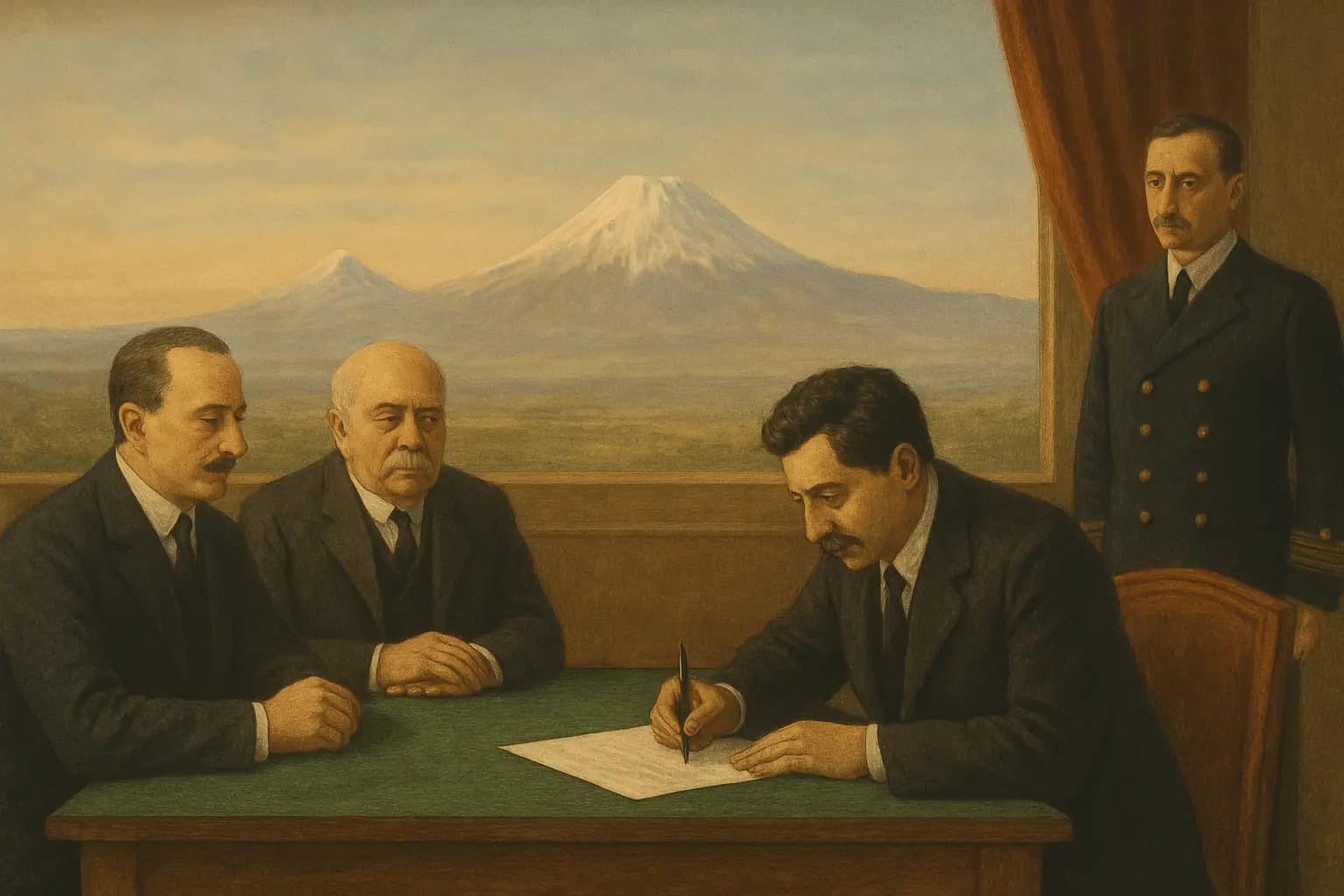
On that day, in the famous porcelain showroom of the Sèvres suburb of Paris, a treaty was signed that was meant to bring a final end to World War I in the Middle East and legally formalize the dissolution of the Ottoman Empire. For the Armenians, however, it was more than just an international document; it was the cornerstone for the restoration of justice after the horrors of the Armenian Genocide and the legal foundation for a unified, independent homeland. The Treaty of Sèvres became the birth certificate of "Wilsonian Armenia"—a state that, while never fully realized, continues to stand as an irrefutable testament to the rights and national aspirations of the Armenian people.
The Road to Sèvres: Diplomatic Struggles and Great Power Promises
The end of World War I was marked by the collapse of empires and the proclamation of the principle of self-determination, championed primarily by U.S. President Woodrow Wilson. The reality of the Armenian Genocide, perpetrated by the Ottoman Empire, and the significant contributions of the Armenian people to the Allied war effort (through the Armenian volunteer units and the Armenian Legion) created moral and political obligations for the Entente Powers. At the Paris Peace Conference (1919-1920), Armenian interests were represented by two delegations: the delegation of the First Republic of Armenia, led by Avetis Aharonian, and the Armenian National Delegation, representing the Western Armenians, led by Boghos Nubar Pasha.
These two bodies, uniting as the "Delegation of Integral Armenia," presented their vision for the resolution of the Armenian Question to the conference. They demanded the creation of a unified and independent Armenian state that would include the territory of the First Republic of Armenia, the six Armenian vilayets (provinces) of Western Armenia (Van, Bitlis, Erzurum, Kharpert, Diyarbakir, and Sivas), and Cilicia.
After long and complex negotiations, consultations, and clashes of interest among the great powers, the document that would become the Treaty of Sèvres was drafted. It recognized the right to self-determination for the Armenians, Kurds, and Arabs, effectively ending centuries of Turkish dominion over the region.
The Treaty of Sèvres and Armenia: The Legal Foundations
Articles 88 through 93 of the treaty directly pertained to Armenia, defining its international legal status and the mechanism for determining its future borders.
- Article 88: "Turkey, in accordance with the action already taken by the Allied Powers, hereby recognises Armenia as a free and independent State." This article was of decisive importance, as the defeated Turkish state legally confirmed Armenia's independence.
- Article 89: This was perhaps the most famous and crucial provision. Turkey and Armenia agreed to submit the determination of the frontier between them in the vilayets of Erzurum, Trebizond, Van, and Bitlis to the arbitration of the President of the United States of America. President Wilson was to decide not only the boundary line but also to provide Armenia with access to the Black Sea (via the port of Trebizond).
- Article 90: Turkey was to renounce all rights and titles over the territories to be ceded to Armenia.
- Article 92: This article addressed Armenia's borders with its neighbors, Georgia and Azerbaijan, which were to be determined by direct negotiations among the states concerned.
On November 22, 1920, President Woodrow Wilson delivered his Arbitral Award, which was legally binding and attached to the treaty. This decision granted Armenia approximately 90,000 square kilometers (35,000 sq. miles) from Western Armenia, including most of the Van and Bitlis provinces, nearly two-thirds of Erzurum, and the eastern portion of Trebizond, including its vital port. This territory, when combined with the existing Republic of Armenia (approx. 70,000 sq. km), would have created the state of "Wilsonian Armenia" with a total area of over 160,000 square kilometers.
Why the Treaty Was Never Implemented: A Collision of Geopolitical Interests
Despite being signed (including by the government of the Ottoman Sultan), the Treaty of Sèvres was never ratified or implemented. The reasons for its failure were multifaceted:
- The Rise of the Kemalist Movement: The Turkish Nationalist Movement, led by Mustafa Kemal Atatürk in Ankara, established an alternative government (the Grand National Assembly of Turkey) and completely rejected the Treaty of Sèvres, viewing it as a national humiliation. The Kemalists began a military struggle to prevent its implementation.
- Diverging Interests of the Allies: The great powers (Great Britain, France, and Italy) lacked a unified policy and the political will to use military force against Turkey to enforce the treaty. They were more preoccupied with dividing their own spheres of influence and soon began to enter into separate agreements with the Kemalists.
- The Role of Soviet Russia: Out of its anti-Entente stance, Bolshevik Russia viewed Kemalist Turkey as a strategic ally. Moscow provided significant financial and military aid to Ankara, strengthening its position against both the Allies and Armenia.
- The Turkish-Armenian War (1920): Taking advantage of the favorable international situation, Kemalist forces attacked the Republic of Armenia in September 1920. Having suffered a devastating defeat and abandoned by the Allies, Armenia was forced to sign the humiliating Treaty of Alexandropol on December 2, which renounced the Treaty of Sèvres and its territorial claims.
As a result of these events, the Treaty of Sèvres was replaced by the Treaty of Lausanne in 1923. In this new treaty, any mention of the Armenian Question or the creation of an Armenian state was completely absent. The Treaty of Lausanne legally recognized the borders of the modern Republic of Turkey, leaving the Armenian people with only a small fragment of their historic homeland.
The Role and Significance of the Treaty Today
Although the Treaty of Sèvres was never implemented, its significance for Armenian legal and political thought remains undeniable.
- A Legal Precedent: Sèvres remains the only multilateral, international legal document in which Turkey has recognized Armenia's independence and agreed to third-party arbitration (by the U.S. President) to determine the Turkish-Armenian border. The Wilsonian Arbitral Award, being a legally binding decision, is considered by many legal scholars to be a document that is still valid today, as it has never been superseded by another arbitral award.
- A Symbol of Restorative Justice: The treaty represented an attempt by the international community to provide restitution and restore justice for the Armenian people in the aftermath of the Genocide. It recognized the Armenians as the indigenous people of their historic homeland and affirmed their inalienable right to self-determination.
- A Political and Ideological Foundation: In the struggle for the Armenian Cause (Hay Dat), the Treaty of Sèvres and the Wilsonian Arbitral Award continue to serve as one of the legal and political justifications for territorial claims and the restoration of historical justice. It is a reminder of what the great powers promised the Armenian people and how those promises were broken due to geopolitical interests.
- A Part of National Identity: The "Dream of Sèvres" has become an integral part of Armenian national identity and collective memory. It symbolizes the lost homeland and the unquenchable aspiration for a unified state.
In conclusion, the Treaty of Sèvres remains one of the most vivid, yet tragic, episodes in international law and diplomacy for the Armenian people. As the pinnacle of a legal victory, it quickly transformed into a symbol of betrayed promises and lost opportunities. However, as a legal and moral argument, it lives on, nourishing the Armenian people's faith in the eventual triumph of justice and the restoration of their rights.
Related articles
 HistoryJanuary 7, 2026
Iran: From a Millennial Empire to the Strict Mandates of the Islamic Republic
5 min read HistoryJanuary 7, 2026
Venezuela: The Tragic Phoenix of Latin America - From Oil Paradise to Geopolitical Nightmare
6 min read LifestyleDecember 9, 2025
Festive Tables Around the World: New Year's Traditions and Their Flavorful Nuances
9 min read HistoryDecember 8, 2025
The Spitak Earthquake: History and Statistics of a Catastrophe (December 7, 1988)
7 min read HistoryNovember 17, 2025
The Horrifying but True Story of a 5-Year-Old Who Became a Mother
4 min read HistoryNovember 7, 2025