
Kond: The Past, Present, and Uncertain Future of Yerevan's Oldest District
You only need to turn off the bustling sidewalk of Mashtots Avenue towards the St. Hovhannes Church and walk a few dozen meters to find yourself in a completely different world.
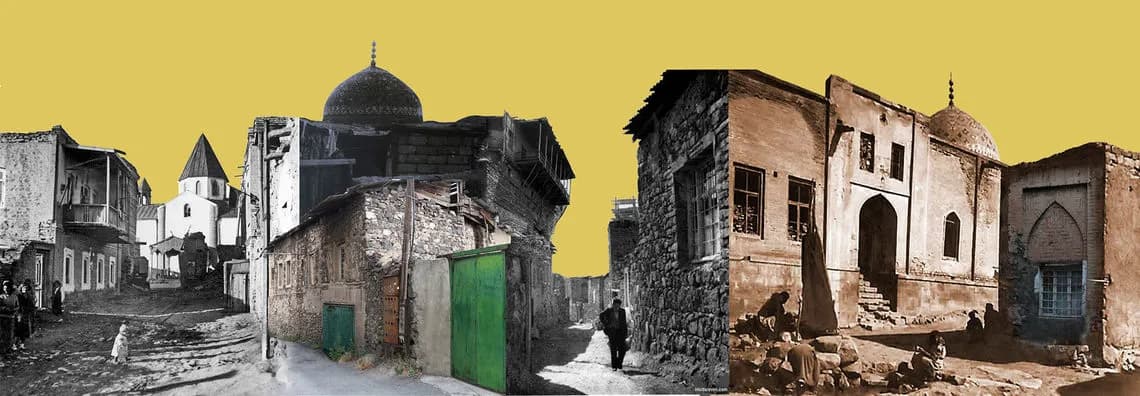
Time seems to stop, the rhythm of the noisy capital is replaced by a village-like tranquility, and multi-story buildings give way to low, stone houses huddled together. This is Kond, one of the three historic districts of Yerevan, a unique world with narrow streets, kind-hearted residents, and an inimitable character.
This is one of Yerevan's hearts that still beats to an old rhythm, yet its future today remains uncertain. This article is a journey into Kond's past, its present, and the complex crossroads at which it stands today.
The Past: Layers of History Beneath the Stones
The history of Kond is the history of Yerevan. The district, which gets its name from the word for "hill," has been one of the city's oldest residential centers.
- Persian Rule: In the 17th-18th centuries, when Yerevan was part of Persia, Kond was one of the city's three main quarters (mahalles), along with Shahar (the Center) and Dzoragyugh. It was primarily inhabited by Armenians and had its own autonomy, governed by a district head (melik). Several churches were located here, of which the reconstructed Saint Hovhannes Mkrtich (John the Baptist) Church survives to this day.
- 19th and early 20th Centuries: As Yerevan grew within the Russian Empire, Kond remained an important part of the city. However, its face changed dramatically after 1915.
- The Post-Genocide Period: Thousands of Western Armenian refugees who survived the Genocide found shelter in Yerevan, and many settled on the slopes of Kond. They began to build small, interconnected houses using whatever materials were at hand - stone, clay, wood. It was during this period that Kond's current architectural look - chaotic, yet at the same time organic and charming - was formed.
The Present: A Village in the Heart of the City
Walking through Kond today is like finding yourself in a labyrinth. Narrow, cobbled streets are tangled like a web, houses seem to climb on top of one another, and laundry lines stretch from one balcony to the next. Life here flows at its own unique pace.
Residents know each other by face, doors are often open, children play in the streets, and grandmothers sit in front of their doors chatting. This is a model of community life that has almost vanished from modern cities.
"I was born in this house, I've lived here for 70 years," says Mrs. Anahit, a resident of Kond. "I know every stone, every neighbor like a sister or brother. This district is our home, our memory. We can't imagine ourselves anywhere else."
However, behind this romantic image lie serious problems: a lack of proper sewage, dilapidated roofs, and issues with gas and water supply. The residents of Kond live between history and uncertainty, preserving their identity while facing the challenges of modern life.
The Architectural Value: A Living Museum
The architectural value of Kond lies not in individual magnificent buildings, but in the entire urban fabric of the district. It is a unique example of "vernacular" architecture, shaped not by the blueprints of architects, but by the dictates of life itself.
- Organic Structure: The streets follow the relief of the hill, creating an unpredictable and human-scale environment.
- Layering: In the district, one can see the remnants of 19th-century Persian or Yerevan-style houses, upon which Soviet and post-Soviet extensions have been added. This is a living map of Yerevan's history.
- Materials and Atmosphere: The combination of tuff, river stone, clay, and wood creates a uniquely warm and familiar atmosphere.
Kond is one of the last islands of Yerevan's historical memory that still preserves its pre-Soviet spirit.
The Future: Preserve or Reconstruct?
Today, the future of Kond is at the center of discussions and debates. There are two main, conflicting points of view.
- Proponents of Radical Reconstruction: According to this viewpoint, Kond is a dilapidated, unsanitary, and dangerous district in the city center. They propose demolishing most of the old buildings and constructing modern hotels, residential complexes, and business centers in their place. This, they argue, would improve the city center and attract investment.
- Proponents of Preservation and Rehabilitation: The members of this group—architects, urbanists, cultural figures, and residents—insist that demolishing Kond is equivalent to erasing a vital page of Yerevan's history. They propose a "gentle" rehabilitation program: strengthening historic buildings, modernizing infrastructure, and preserving the district's architectural spirit and atmosphere. According to this model, Kond could become a tourist and cultural center with art studios, small cafes, and guesthouses, much like the old districts of Tbilisi or Lisbon.
The fate of Kond is not just an architectural or economic issue. It is a question about what kind of city we want to see in the future. Should Yerevan strive to become a faceless, modern metropolis, erasing the last traces of its past, or should it find ways to harmonize the new and the old, preserving its unique character and memory? While the answers to these questions are still pending, Kond continues to live its life as a living monument and a silent reproach to the indifference of the modern city.
Related articles

 HistoryJanuary 7, 2026
Venezuela: The Tragic Phoenix of Latin America - From Oil Paradise to Geopolitical Nightmare
6 min read LifestyleDecember 9, 2025
Festive Tables Around the World: New Year's Traditions and Their Flavorful Nuances
9 min read LifestyleNovember 10, 2025
When Steel Starts to Think: China’s Robots Step Out of the Lab
10 min read HistoryOctober 27, 2025
How the €88 Million Heist Shook the Louvre and Awakened the Ghost of the Mona Lisa
12 min read HistoryOctober 18, 2025
The Gaza Conflict: How It Started, Why It Persists, and Where It Might Go
9 min read LifestyleOctober 10, 2025