
When Steel Starts to Think: China’s Robots Step Out of the Lab
China is no longer just a manufacturing giant – it’s becoming the symbol of a nation made of thinking steel. XPENG’s humanoid robots, robot-run malls, and embodied intelligence technologies prove the future has already arrived.
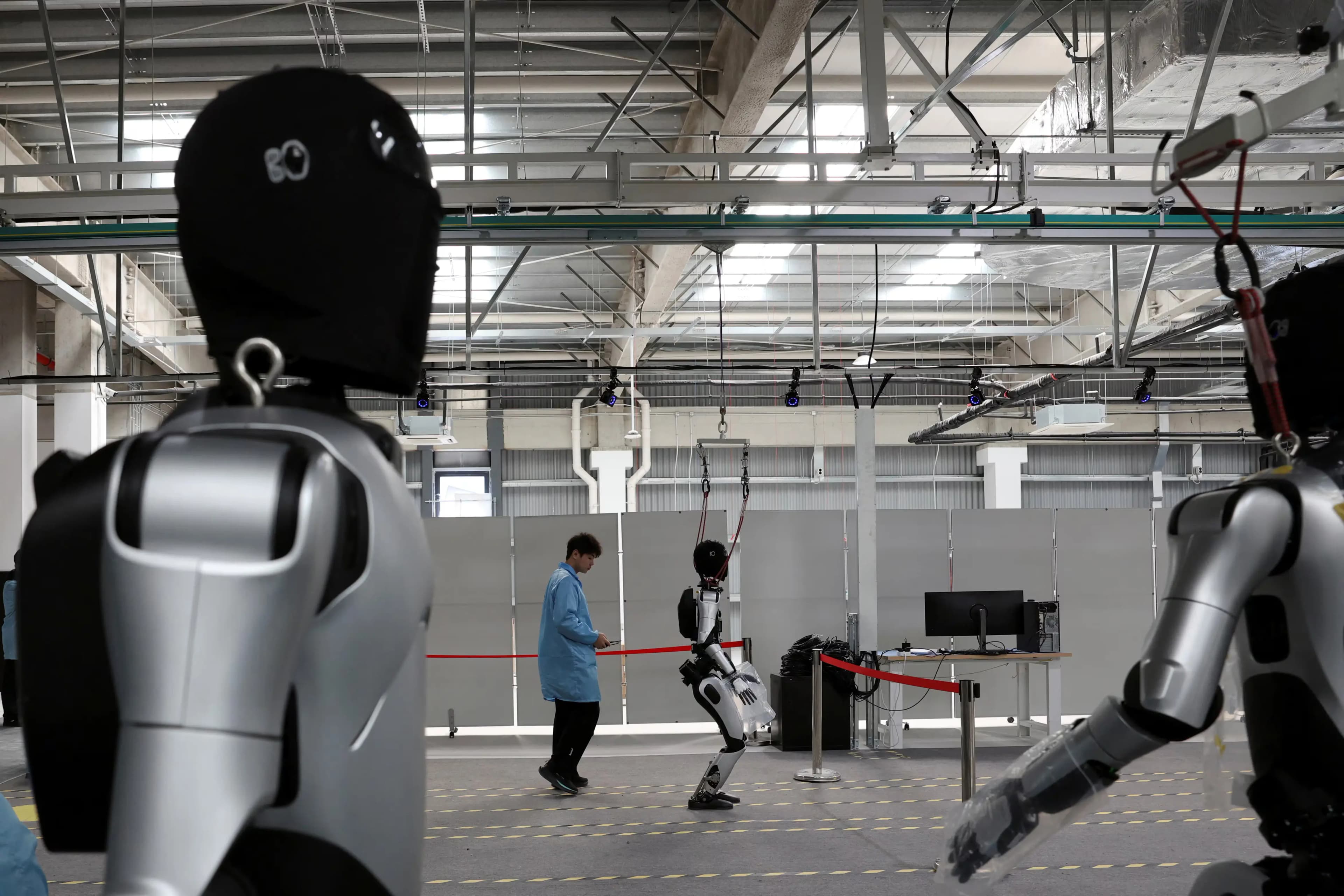
Not long ago, the idea of a humanoid robot walking among us belonged to science fiction. Today, it’s not only real — it’s Made in China.
In the past two years, China’s robotics industry has exploded beyond imagination, with AI-powered humanoid robots, autonomous service bots, and smart factory systems reshaping how the nation thinks about labor, production, and even identity.
This is not about gadgets or toys. It’s about a trillion-dollar national strategy that blends artificial intelligence, advanced hardware, and industrial might. As Western countries debate regulation and ethics, China is moving forward - fast, boldly, and with state backing that could turn it into the undisputed robotics capital of the world.
A Humanoid Revolution Begins
In late 2025, the internet was set ablaze by a video from XPENG Robotics, the same company known for its futuristic electric vehicles. Their humanoid robot, codenamed “IRON,” moved with such lifelike precision that millions online suspected there was a human hidden inside. XPENG had to literally cut open the robot on stage to prove it was 100% machine.
“We are not building robots to mimic humans,” said XPENG CEO He Xiaopeng. “We are building robots to enhance what humans can achieve.”
This moment marked a turning point — not just for XPENG, but for China’s entire robotics landscape. It signaled the shift from prototype to production, from spectacle to scalability. XPENG has since announced plans to mass-produce humanoids by 2026, targeting logistics, factory operations, and elderly care sectors.
And XPENG isn’t alone. From Fourier Intelligence’s GR-1 to Unitree’s H1, Chinese robotics firms are now competing to build the most advanced humanoids in the world — capable of walking, lifting, conversing, and reacting to dynamic environments.
Beyond Movement: The Rise of “Embodied Intelligence”
China’s robotics push isn’t just about mechanical engineering — it’s about embodied intelligence.
That term, popularized by AI researchers, means creating robots that can see, understand, and act in the physical world. Instead of being pre-programmed for repetitive tasks, these robots learn from real-world experience.
China’s tech giants are integrating multimodal AI models — vision, language, and action — into their robots. These systems combine camera vision, natural-language processing, and environmental feedback loops to make autonomous decisions.
The result? Robots that can not only move smoothly, but also interpret commands like:
“Pick up the red box next to the door, then deliver it to the reception desk.”
In other words, robots that understand context — not just code.
According to 36Kr, one of China’s top tech journals, the market for embodied-intelligence robotics reached ¥418.6 million ($58 million) in 2024 and surged past ¥529 million in the first half of 2025. Over 200 startups now operate in this subfield - many funded by national and provincial AI grants.
From Factories to Malls: Robots Go Mainstream
The Chinese government calls robots “the new productive force.” But the real “wow” stories are happening far from factories.
In early 2025, Shenzhen opened the world’s first “Robot Mall.”
Every café, cashier, and cleaning service inside is run by robots. Humanoid guides greet visitors, AI baristas brew coffee, and mechanical servers deliver food. The mall is not just a marketing stunt — it’s a live experiment in social robotics.
“We wanted to see what happens when humans become the minority,” said one of the project’s engineers.
The experiment is revealing something profound: people adapt quickly. Many visitors reportedly forget they’re interacting with machines after a few minutes. That’s precisely what Chinese designers are aiming for - seamless human-robot coexistence.
Scale Like No Other
Numbers tell the story better than anything.
- In 2024 alone, China installed nearly 295,000 industrial robots, almost 10 times more than the United States, according to the International Federation of Robotics.
- Over 60% of new global robot installations now occur in China.
- Local companies dominate: Siasun, Estun, Efort, and Unitree have replaced foreign brands in many factories.
This isn’t just a manufacturing race. It’s a strategic redirection of the national economy — away from cheap labor, toward intelligent automation.
State policies like “Made in China 2025” and “New Productive Forces” explicitly call robotics a “pillar industry.” The government subsidizes robot purchases, funds AI-chip research, and builds dedicated “robot industrial parks” across provinces like Guangdong, Zhejiang, and Jiangsu.
The Political Engine Behind the Bots
Let’s be clear: China’s robotics boom isn’t purely a tech miracle — it’s a political project.
Facing an aging population and shrinking workforce, Beijing sees robotics as the only way to sustain productivity growth. A robot can work 24 hours a day, never take a sick day, and doesn’t need housing.
But beyond economics, there’s prestige. The government wants to prove that the next industrial revolution won’t be led by Silicon Valley or Tokyo — it will be Made in China.
That ambition has turned robotics into a national obsession. Universities are expanding robotics programs. Venture capital is flowing. Even the People’s Liberation Army is experimenting with semi-autonomous robots for logistics and reconnaissance.
“Living Steel” – The Design Philosophy
Unlike Japan’s approach, which emphasizes human-like emotion, China’s robotics aesthetic is pragmatic. The focus is efficiency and realism.
Designers aim for a balance between familiarity and precision — robots that look friendly enough for public interaction, yet industrial enough to be taken seriously.
Take XPENG IRON again: matte silver finish, lightweight carbon frame, mechanical eyes that display minimal emotion but convey intent.
Designers say this was intentional - the goal was not to make it “cute,” but to make it trusted.
From a design perspective, this marks a turning point. Human-robot interaction (HRI) in China is being guided by psychology and ergonomics, not just mechanics. Robots must fit into crowded public spaces, adapt to eye-level interaction, and manage cultural expectations of politeness and hierarchy.
The “Robotization” of Daily Life
While the West debates robot ethics, China is already testing everyday integration.
- Hotels in Beijing now use humanoid bell-bots that carry luggage.
- Hospitals deploy nursing robots to transport medicine between wings.
- Restaurants in Chengdu and Hangzhou use robot waiters that recognize repeat customers.
- Schools experiment with “AI tutors” that help students practice English conversation.
Perhaps the most telling example is in elderly care homes — where robots not only deliver food and monitor health but also chat with residents.
These developments align with demographic reality: China’s elderly population is projected to exceed 400 million by 2035. Robots aren’t replacing humans — they’re filling a gap that no longer can be closed by labor alone.
Challenges and Controversies
Of course, not everything about this robotic rise is shiny steel and smooth silicone.
- Employment Displacement:
- While official rhetoric claims robots “liberate humans from dull work,” labor experts warn of mass redundancy in manufacturing and logistics sectors.
- Data Privacy:
- Social robots collect video, voice, and behavioral data — raising major privacy concerns in a country already under heavy surveillance.
- Safety and Ethics:
- When humanoid robots share public spaces, even minor malfunctions can have legal implications. China’s regulatory framework is still evolving, with draft laws on robot liability under discussion.
- Authenticity and Trust:
- As robots become more lifelike, humans risk developing emotional attachments to them - a phenomenon psychologists call the empathy trap. In China’s collectivist culture, where harmony and loyalty are prized, this could create unexpected psychological dynamics.
The Economic Logic of a Robot Nation
China’s strategy is brutally rational.
Robots don’t unionize, don’t strike, and can be upgraded with a software patch.
With wages rising and population aging, automation isn’t optional — it’s survival.
By 2030, analysts expect one in every three manufacturing tasks in China to be performed by robots.
The potential payoff is enormous:
- Higher productivity per capita.
- Precision manufacturing for chips, EVs, and aerospace.
- Global export of robot technology — not just consumer goods.
And with domestic players already exporting to Southeast Asia, the Middle East, and Africa, China could soon own the global robotics supply chain just as it dominates solar panels and EV batteries.
The Cultural Shift: From “Workers” to “Controllers”
Walk into a next-generation factory in Suzhou, and you won’t see workers in blue uniforms. You’ll see supervisors behind glass, monitoring robots through dashboards.
China’s new working class isn’t made of laborers — it’s made of controllers.
The shift is as cultural as it is economic. The image of the “Chinese worker” — once the symbol of mass labor - is transforming into the “Chinese operator,” a human in charge of intelligent machines.
What It Means for the World
China’s robotic rise raises existential questions for everyone else.
Can democracies compete with an authoritarian model that can redirect entire industries overnight?
Will Western companies outsource automation to China the way they once outsourced labor?
And how will global supply chains adjust when “Made by China” becomes “Made by Chinese Robots”?
Conclusion: When Steel Thinks, What Happens to Us?
As China races ahead, one truth becomes clear: the era of passive machines is over. The new machines see, decide, and act.
They’re no longer just tools - they’re agents.
But the deeper story isn’t about China building robots. It’s about China becoming one - a nation engineered for relentless efficiency, adaptive intelligence, and centralized control.
When steel starts to think, humanity faces a mirror.
And in that reflection, we might not see just China’s future - we might see our own.
Related articles

 LifestyleDecember 9, 2025
2025 Cinema Chronicle: The Best 5 Films and 5 Series of the Year
9 min read LifestyleDecember 9, 2025
Festive Tables Around the World: New Year's Traditions and Their Flavorful Nuances
9 min read LifestyleNovember 5, 2025
The Shadow Kingdom of Dreams: What Are Our Nightly Visions Trying to Tell Us?
12 min read LifestyleOctober 31, 2025
The Taurus Zodiac: The Emblem of Groundedness, Loyalty, and Sensuality
9 min read LifestyleOctober 28, 2025
The Hidden Dangers of the Supermarket: What Are We Really Eating and Using Every Day?
17 min read LifestyleOctober 10, 2025