
The Gaza Conflict: How It Started, Why It Persists, and Where It Might Go
The Gaza conflict explained in full: how it began after the fall of the Ottoman Empire, why peace remains impossible, and what lies ahead. A detailed historical and political analysis of one of the world’s longest-running wars.
1. The Origins – The End of the Ottoman Empire and the British Mandate
From Ottoman Rule to British Control
Until the early 20th century, Palestine (including modern-day Gaza) was part of the Ottoman Empire. Arabs, Jews, and Christians lived there under Ottoman administration, with the majority being Arab Muslims.
After World War I, the Ottoman Empire collapsed, and Britain took over the region under a League of Nations mandate. That’s when the roots of today’s struggle began to take shape.
The Balfour Declaration (1917)
In 1917, the British government issued the Balfour Declaration, which stated support for “the establishment in Palestine of a national home for the Jewish people.”
This was the turning point. Britain promised the same land to two groups: Jews seeking refuge and national revival, and Arabs who had lived there for centuries. It created a contradiction that would later explode into full-scale conflict.
2. The Rise of Zionism and Jewish Immigration
The early 1900s saw the growth of Zionism – a movement aiming to establish a Jewish homeland in Palestine. The idea was partly a response to centuries of persecution in Europe and the Russian Empire.
After the Holocaust, Jewish immigration to Palestine dramatically increased. For the Jewish people, Palestine symbolized survival and rebirth. For Palestinian Arabs, it looked like colonization – a foreign movement taking over their land with Western backing.
Tensions rose. Violence between Arabs and Jews became common through the 1920s and 1930s. Both sides began forming militias – the Haganah and Irgun on the Jewish side, and various Arab resistance groups.
By the end of World War II, Britain could no longer control the region. The situation exploded into international attention.
3. The UN Partition Plan and the First Arab-Israeli War (1947–1949)
In 1947, the United Nations proposed to divide Palestine into two states:
- A Jewish state
- An Arab state
- And an international zone for Jerusalem
The Jewish leaders accepted the plan, but Arab nations and Palestinian leaders rejected it, seeing it as unfair and illegitimate.
On May 14, 1948, the State of Israel declared independence. Within hours, Egypt, Jordan, Syria, Lebanon, and Iraq invaded.
The result: Israel survived and even expanded beyond the UN’s proposed borders. Around 700,000 Palestinians fled or were expelled – an event they call Nakba (“The Catastrophe”).
Gaza fell under Egyptian control, becoming a narrow, overcrowded refuge for displaced Palestinians.
4. The Six-Day War and Israeli Occupation (1967)
In June 1967, during the Six-Day War, Israel captured the Gaza Strip, the West Bank, and East Jerusalem. From then on, Gaza became an occupied territory.
The war transformed everything:
- Israel gained strategic military control.
- Palestinians lost what was left of their land.
- The dream of a Palestinian state became even more distant.
After 1967, Israel began building settlements in occupied areas, which are considered illegal under international law. For Palestinians, this was proof that occupation had turned into colonization.
5. The Rise of Hamas and Palestinian Resistance
The First Intifada (1987–1993)
By the late 1980s, frustration boiled over. Gaza’s youth, facing daily humiliation and poverty, erupted in protest. The First Intifada began in December 1987 – a grassroots uprising against Israeli rule.
During this time, a new Islamist organization was born: Hamas (Harakat al-Muqawama al-Islamiyya – Islamic Resistance Movement).
Hamas originated as a branch of Egypt’s Muslim Brotherhood. Its ideology combined nationalism and religion – aiming not just for liberation, but for an Islamic state in all of historical Palestine.
The Oslo Accords (1993) and Broken Promises
In 1993, Israel and the Palestine Liberation Organization (PLO) signed the Oslo Accords, creating the Palestinian Authority and promising a path toward peace.
However, Oslo left critical issues unresolved:
- The status of Jerusalem
- The right of return for refugees
- Settlements and borders
Israel continued expanding settlements; Palestinian trust evaporated. Hamas, rejecting Oslo entirely, gained popular support by calling the peace process a deception.
6. Gaza’s Political Split and the Blockade (2005–2007)
Israel’s “Disengagement” (2005)
In 2005, Israel unilaterally withdrew its troops and settlers from Gaza. On paper, Gaza was “liberated.” In reality, Israel retained control over airspace, coastline, and borders.
The move was seen by many as a strategic shift – outsourcing control while maintaining isolation.
Hamas Takes Over (2006–2007)
In 2006, Hamas won Palestinian parliamentary elections. The following year, after violent clashes with the rival Fatah party, Hamas took full control of Gaza.
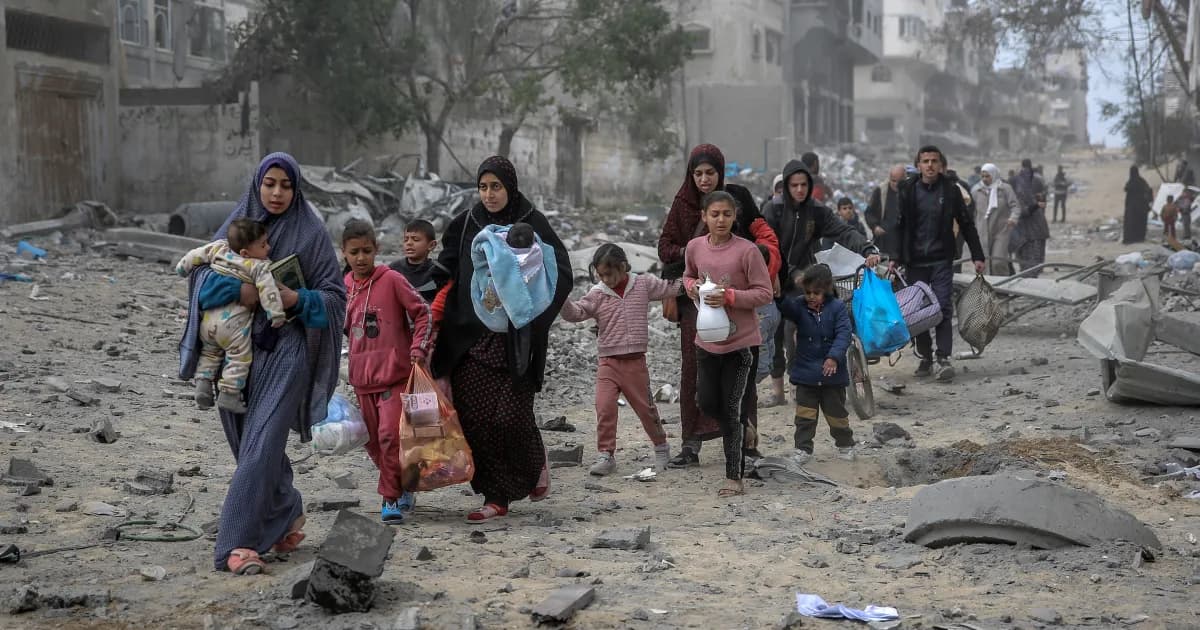
This triggered a total blockade by Israel and Egypt. The goal: to weaken Hamas. The effect: to suffocate 2 million civilians.
Since then, Gaza has been described as “the world’s largest open-air prison.” Electricity, water, food, and medicine flow under tight restrictions. Economic life collapsed.
Meanwhile, Hamas continued rocket attacks, and Israel responded with massive airstrikes. Civilians on both sides suffered.
7. The Wars of Gaza – 2008, 2014, 2021, 2023
Since Hamas took power, Gaza and Israel have fought multiple wars:
2008–2009: Operation Cast Lead
Israel launched a three-week offensive after heavy rocket fire. Over 1,300 Palestinians and 13 Israelis were killed. The destruction was enormous.
2014: Operation Protective Edge
A seven-week war left 2,200 Palestinians dead (mostly civilians) and 73 Israelis. Entire neighborhoods in Gaza were wiped out.
2021: The 11-Day War
Triggered by tensions in Jerusalem’s Sheikh Jarrah neighborhood, the conflict killed 260 Palestinians and 13 Israelis. Once again, ceasefire came without resolution.
2023–2025: The Bloodiest Chapter
On October 7, 2023, Hamas launched an unprecedented attack on Israeli towns, killing around 1,200 people and taking hundreds of hostages.
Israel responded with a full-scale invasion of Gaza – the most devastating in its history. By late 2024, over 35,000 Palestinians had been killed, according to UN estimates. Hospitals, schools, and homes were reduced to rubble.
The humanitarian collapse became total – no clean water, no fuel, no functioning healthcare. The UN called it “a hell on earth.”
8. Why Peace Never Lasts
8.1 Competing Claims of Legitimacy
Both nations claim moral and historical ownership:
- Israelis see the land as their biblical homeland and survival necessity.
- Palestinians see it as their ancestral homeland stolen under colonial protection.
There is no compromise between those two narratives – yet peace requires exactly that.
8.2 Distrust and Political Paralysis
Each side distrusts the other’s intentions. Israel fears annihilation; Palestinians fear permanent occupation.
Moderates on both sides have been politically destroyed, while extremists thrive on endless conflict.
8.3 International Hypocrisy
The international community preaches peace but funds war. Western nations arm Israel; Iran and Qatar support Hamas. The UN issues resolutions, but enforcement never follows.
The result is a status quo built on death.
8.4 Gaza’s Blockade and Humanitarian Collapse
Even without bombs, Gaza suffers daily under blockade. Unemployment exceeds 45%, water is undrinkable, and most families depend on food aid.
Children are growing up knowing only war and hunger – the perfect recipe for generational trauma and radicalization.
9. The Global Dimension
The Gaza conflict is no longer just a regional issue. It’s a mirror of global failure:
- The West sees it through the lens of terrorism and security.
- The Arab world sees it through oppression and resistance.
- The Global South sees it as proof of double standards in international law.
Meanwhile, real people – civilians, families, children – pay the price for political theater.
10. Armenia and the Caucasus Perspective
For Armenia and the South Caucasus, the Gaza situation is a grim but instructive parallel.
It shows what happens when:
- Two peoples claim the same land.
- Outside powers manipulate the conflict for decades.
- Peace becomes a slogan instead of a strategy.
The lesson is not about choosing sides, but about seeing the cost of endless insecurity. No one wins in a permanent state of war – not militarily, not morally, not economically.
11. What Could Happen Next
There are four main scenarios experts discuss today:
- A negotiated two-state solution – still the official UN position, but politically frozen.
- Status quo continuation – periodic wars, no peace, no reconstruction.
- Total escalation – regional war involving Lebanon, Iran, or Egypt.
- International trusteeship or reconstruction plan – rebuilding Gaza under global administration while deferring final political status.
None of these are easy. All require trust, which doesn’t exist.
12. Conclusion – A Conflict That Defines Humanity’s Limits
The Gaza conflict is not just about borders. It’s about identity, fear, trauma, and survival. It’s about a people who feel unseen, and another who feel eternally threatened.
It’s also about a world that has learned to live with injustice, as long as it’s far away.
Every explosion in Gaza echoes beyond the Middle East – it questions the very idea of human civilization. Can we live in peace when one side’s freedom is built on another’s despair?
Until that question is answered honestly, Gaza will remain what it has always been: a small piece of land that contains the whole tragedy of the modern world.
Related articles
 HistoryJanuary 7, 2026
Iran: From a Millennial Empire to the Strict Mandates of the Islamic Republic
5 min read HistoryJanuary 7, 2026
Venezuela: The Tragic Phoenix of Latin America - From Oil Paradise to Geopolitical Nightmare
6 min read LifestyleDecember 9, 2025
Festive Tables Around the World: New Year's Traditions and Their Flavorful Nuances
9 min read HistoryDecember 8, 2025
The Spitak Earthquake: History and Statistics of a Catastrophe (December 7, 1988)
7 min read HistoryNovember 17, 2025
The Horrifying but True Story of a 5-Year-Old Who Became a Mother
4 min read HistoryNovember 7, 2025