
Karahunj: The Mystery of the Armenian Stonehenge
In the highlands of southern Armenia's Syunik Province, where the sky seems unusually close and the wind whispers stories of centuries, lies one of the planet's most mysterious sites: Karahunj.
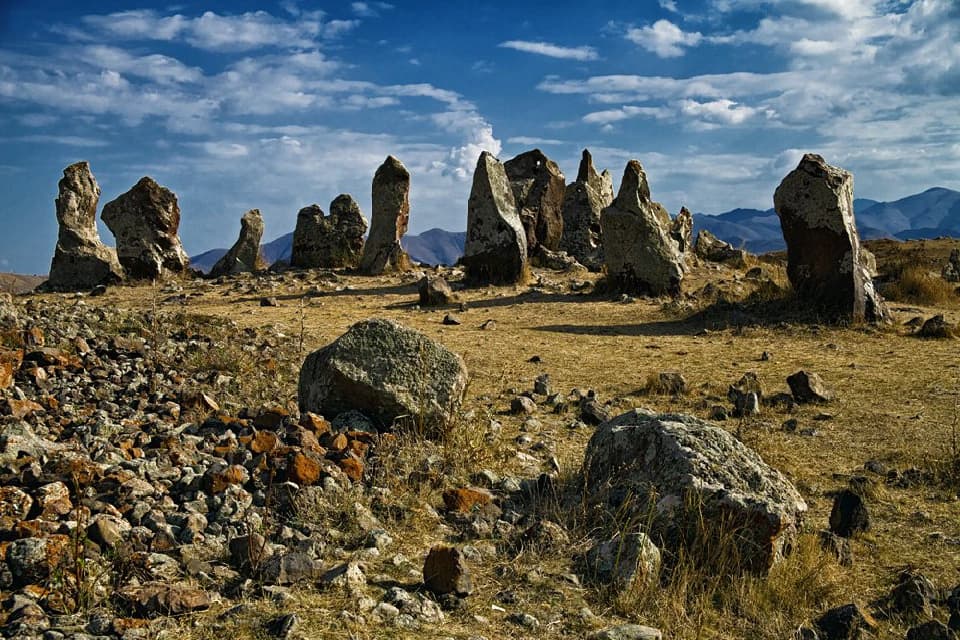
More than two hundred giant, upright stones, or menhirs, form a complex often called the "Armenian Stonehenge." However, this comparison is merely the beginning of a debate that has raged for decades in scientific circles. Is this the world's oldest astronomical observatory, predating the Egyptian pyramids, or is it a powerful spiritual center built to honor gods and the dead?
This article is a fascinating journey into the heart of the Karahunj mystery, exploring scientific theories and historical hypotheses.
What is Karahunj? The Army of Stones and the Speaking Stones
The complex, also known in scientific literature as Zorats Karer ("Stones of the Army" or "Stones of Power"), covers an area of about 7 hectares. It consists of 223 basalt stones, some reaching up to 3 meters in height and weighing up to 10 tons. Most of the stones are arranged in two sprawling arms that form an egg-shaped structure in the center with a diameter of 40 meters.
But the most significant feature of Karahunj, which sets it apart from other megalithic structures in the world, is the holes drilled through 84 of the stones. These circular holes, 4-5 cm in diameter, seem to be aimed at different points on the horizon, giving rise to the main question: for whom and for what purpose were they created?
Theory 1: The World's Oldest Observatory
The most famous and energetic proponent of this theory was the academician Paris Herouni. After a series of expeditions between 1994 and 2001, he reached a stunning conclusion.
- Age: According to Herouni's astronomical calculations, Karahunj was built more than 7,500 years ago (6th millennium BCE). If this is true, Karahunj is about 3,500 years older than Britain's Stonehenge and 3,000 years older than the Egyptian pyramids.
- Purpose: Herouni argued that the holes served as primitive "telescopes." By looking through them, ancient people could observe the position of the sun, moon, and specific stars with great accuracy during different seasons. He claimed that many of the holes were aimed at the rising points of stars such as Deneb, Vega, and Capella thousands of years ago.
This theory transforms Karahunj from a mere monument into a testament to the development of civilization, changing our understanding of the knowledge possessed by prehistoric people.
Theory 2: The Ritual Complex and Necropolis
Despite the appeal of the observatory theory, most archaeologists have a more cautious approach. They rely on the results of excavations, which tell a different story.
- Age: Archaeological findings (pottery, tools) indicate that the complex was mainly active during the Bronze and Iron Ages (2000-1000 BCE), which would make it a contemporary of Stonehenge, but not significantly older.
- Purpose: A stone burial chamber (a dolmen) was discovered inside the central ellipse, suggesting that the core of the structure was the burial site of a powerful leader or priest. Numerous other graves have also been found on the site. This leads to the belief that Zorats Karer was a necropolis (a city of the dead) and a ritual center where ceremonies related to funerals and ancestor worship took place.
According to this theory, the rows of stones could have served as processional avenues or to demarcate a sacred area.
Karahunj vs. Stonehenge: Similarities and Differences
Both structures share a number of common features. They are both megalithic complexes with circular arrangements of stones, and the purpose of both remains mysterious to this day. Both Karahunj and Stonehenge are linked to astronomy, although the connection of Stonehenge to the solstices is proven, while for Karahunj, it remains a theory.
However, the differences are more numerous and significant. Regarding age, there is a debate surrounding Karahunj: according to Paris Herouni, it is 7,500 years old, whereas archaeologists date it to 3,000-4,000 years old. Stonehenge is about 4,500-5,000 years old. As for materials and construction, Karahunj is built from local, relatively small, and unworked basalt stones. In contrast, the giant stones of Stonehenge were processed, polished, and brought from hundreds of kilometers away, and the structure has a complex system with horizontal lintels. Finally, the unique feature: Karahunj's exclusive characteristic is the holes drilled through many of its stones, while Stonehenge's is its complex, complete circle created with horizontal slabs.
The Mystery of the Holes: Telescope or Technical Necessity?
- The Astronomical View (Herouni): The holes narrowed the field of vision, allowing for more precise fixing of a star's rising point. They were primitive observation tools.
- The Archaeological View: Proponents of this view offer several alternatives. The holes could have been used for ropes to transport the stones. They might also have had a ritualistic meaning, for example, as "spirit holes" through which, according to beliefs, the soul of the deceased left the body. Some scientists also note that the holes are crudely made and not all of them could have served for precise observations.
Recent Research and Unanswered Questions
In recent years, specialists from the Institute of Archaeology and Ethnography of the National Academy of Sciences of Armenia have continued to study the complex using modern technologies (georadar scanning, 3D modeling). New research mainly reinforces the theory of the complex's Bronze Age origin and its function as a ritual-funerary center.
However, this does not mean the astronomical hypothesis is completely dismissed. It is possible that the truth lies somewhere between the two theories. Karahunj could have been a multifunctional center: both a necropolis and a ritual site, as well as a place where people observed celestial bodies to regulate their agricultural and spiritual lives.
The true power of Karahunj, perhaps, lies precisely in its unanswered questions. Regardless of whether it is 7,500 or 4,000 years old, it remains an impressive testament to the power of human thought and will. Zorats Karer is not just a pile of stones, but a bridge connecting us to our ancestors, a place where history, science, and national identity meet. By visiting Karahunj, anyone can stand next to these giants, listen to the song of the wind in their holes, and try to solve the eternal mystery of the "speaking stones" for themselves.
Related articles

 HistoryJanuary 7, 2026
Iran: From a Millennial Empire to the Strict Mandates of the Islamic Republic
5 min read HistoryJanuary 7, 2026
Venezuela: The Tragic Phoenix of Latin America - From Oil Paradise to Geopolitical Nightmare
6 min read LifestyleDecember 9, 2025
Festive Tables Around the World: New Year's Traditions and Their Flavorful Nuances
9 min read HistoryDecember 8, 2025
The Spitak Earthquake: History and Statistics of a Catastrophe (December 7, 1988)
7 min read HistoryNovember 17, 2025
The Horrifying but True Story of a 5-Year-Old Who Became a Mother
4 min read HistoryNovember 7, 2025