
The Irreversible Descent: 28 Hours Upside Down in a 10-Inch Crevice, and the Man Who Remained Trapped Forever
In human history, there are events that force us to re-evaluate the limits of our own capabilities against the unforgiving power of nature. This is one of those stories. This is the story of John Edward Jones, whose 28-hour fight for life, nearly 100 feet underground and upside down, shocked the world and sealed the entrance to one of America's most famous caves forever.
Who Was John Jones?
In 2009, 26-year-old John Jones was in the prime of his life. He was a medical student living in Virginia with his beloved wife, Emily, and their one-year-old daughter. Emily was pregnant with their second child. For the Thanksgiving holiday, the family had traveled to Utah to visit John's parents and brothers.
John had been a passionate caver (speleologist) since childhood. His family often went on expeditions, and he and his brother, Josh, had explored Utah's caves many times. The Nutty Putty Cave held a special place for them; it was the scene of their childhood adventures. John wanted to relive those feelings and share them with his friends.
The Fateful Location: Nutty Putty Cave
The Nutty Putty Cave, located not far from Salt Lake City, was famous for its unusual structure. It consisted not of large chambers, but of incredibly narrow, winding passages formed by hydrothermal water flows. It got its name ("Nutty Putty") from the soft, putty-like clay on its walls. It was a popular spot for scouts and novice adventurers, as it was considered relatively safe. However, it was also deceptive. Before 2009, at least six people had been rescued after getting lost or stuck within its passages.
On the evening of November 24, 2009, around 8:00 PM, John, his brother Josh, and 9 other friends entered the cave.
One Wrong Turn
After a while, the group split up. John and Josh decided to find a famous, difficult-to-pass but manageable tight spot known as "The Birth Canal." John, who was quite tall (about 6 feet, or 183 cm), led the way.
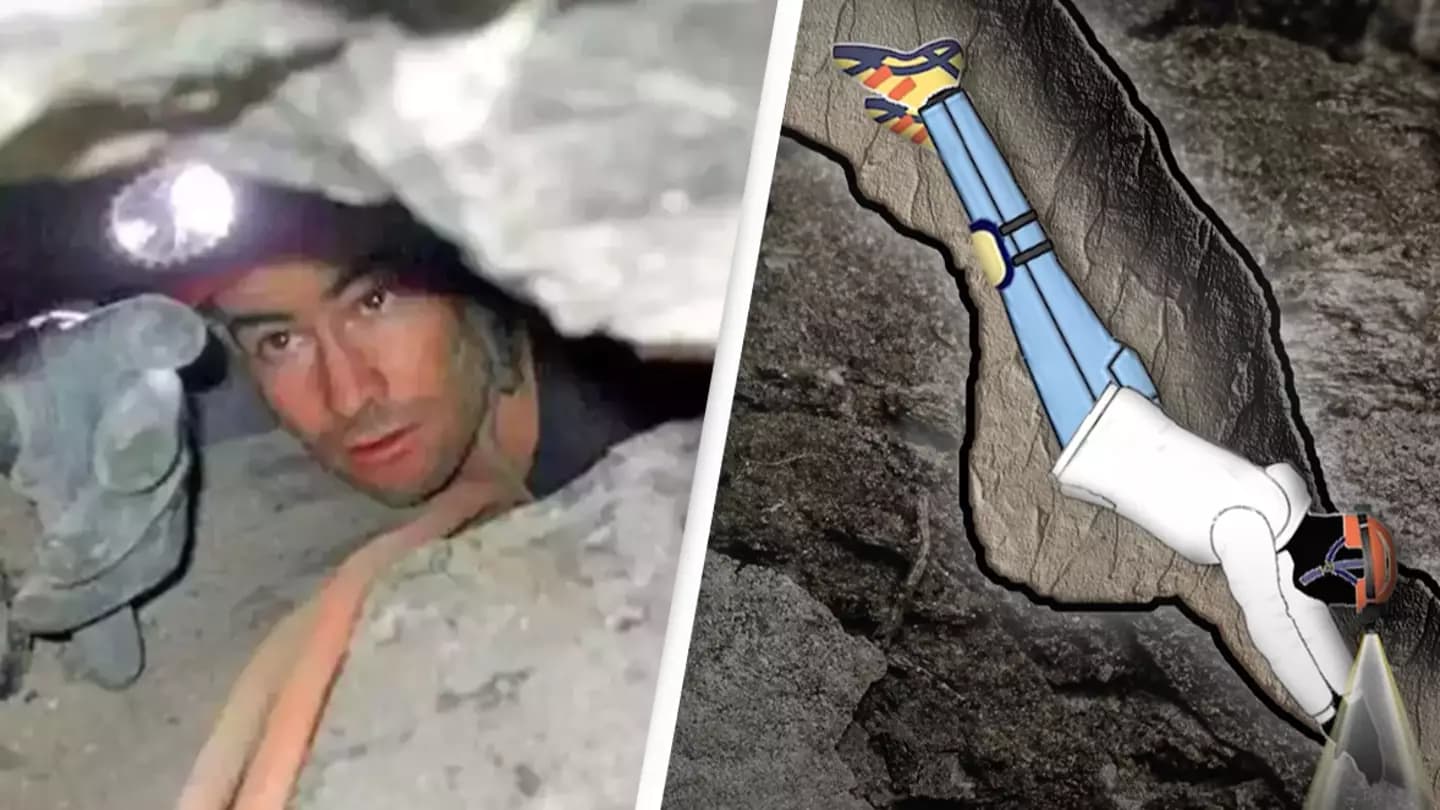
He spotted a narrow opening and, believing it was The Birth Canal, began to crawl into it headfirst. He soon realized his mistake. This was not a mapped passage, but a deadly dead-end. He tried to move backward but couldn't. His movements only wedged him deeper and deeper.
Finally, he slid all the way down. John Jones found himself in a trap, later named "Bob's Push." He was about 100 feet (30 meters) below the surface and roughly 400 feet (120 meters) from the main entrance.
His position was unimaginable: he was stuck at a 70-degree angle, upside down. The crevice was so narrow he couldn't even fully expand his chest to breathe. The dimensions of the passage at that point were approximately 18 inches (45 cm) wide and only 10 inches (25 cm) high.
The 28-Hour Race Against Time
The first person to reach him was his brother, Josh. He could only see John's sneakers sticking out of the narrow hole. Josh tried to pull him, but John was immobile. Realizing the gravity of the situation, Josh crawled out of the cave and called for help.
Thus began one of the most complex rescue operations in Utah's history.
The first rescuer, Susie Motola, reached John just after midnight on November 25th. She understood the situation was almost hopeless. John was upside down, his arms pinned against his body, his feet in the air. Remaining upside down for an extended period is lethal: the heart cannot indefinitely fight gravity to pump blood from the upper body back to the legs. Blood pools in the head, putting pressure on the brain and eyes, while the lungs fill with fluid.
John, however, was surprisingly calm. He joked with the rescuers, saying, "Hi, Susie. Thanks for coming, but I'm really, really stuck."
Over 130 rescuers worked in relentless shifts. They knew time was running out. The main problem was that the passage was so tight only one rescuer could get close to John at a time.
A Moment of False Hope
The rescuers devised a complex plan. They decided to use a system of pulleys and ropes. They would have to drill holes into the cave walls for anchors, attach a rope to John's feet, and carefully pull him back up. All of this was done in an impossibly confined space.
After hours of drilling, the system was ready. They began to pull. John screamed in pain but felt himself moving. The rescuers managed to lift him about three feet (one meter). It was a huge victory. It seemed like it would work. They gave John water (via an IV line) and were even able to pass a police radio down to him so he could speak to his wife, Emily, who was waiting anxiously at the entrance.
They spoke. John told her he loved her and that he was going to get out and come home.
The Irreversible Failure
And just at that moment, when hope was at its peak, disaster struck.
One of the main anchors for the pulley system, which had been secured into the soft, clay-like wall of the cave, failed under the combined force of John's weight (about 190 lbs, or 86 kg) and gravity. The anchor point ripped out.
John Jones slid back down with terrible force, falling back into the same crevice, but this time even deeper and more tightly wedged than before. A rescuer who was holding the rope was also injured.
This was the end. John was now stuck in an impossibly worse position.
His condition deteriorated rapidly. After hours of being inverted, his body could no longer hold on. His breathing became irregular, and he began to lose consciousness. Rescuers continued to talk to him, but his responses grew weaker and weaker.
Just before midnight on November 25, 2009—nearly 28 hours after entering the cave—John Jones stopped responding. A rescuer managed to get close enough to check for vital signs. There were none. John Edward Jones had died of cardiac arrest and suffocation.
The Aftermath: A Cave as a Tomb
The rescue operation turned into a recovery mission, but it soon became clear that this, too, was impossible. John was wedged so tightly that retrieving his body would require either breaking his legs or demolishing the cave walls with dynamite or heavy equipment. Any of these actions would be lethally dangerous for the rescuers themselves.
After heavy consultation, John's family and the authorities made the most painful, yet the only logical, decision. John's body would remain where he died.
The Nutty Putty Cave was declared John Jones's final resting place. A week later, rescuers collapsed the ceiling near the entrance with explosives, and the main entrance was permanently sealed with concrete, closing it to the public forever.
Today, a plaque is mounted near the sealed entrance, dedicated to John Jones. His tragic story became a lesson, a reminder that the line between adventure and recklessness can sometimes be as thin as 10 inches.
Related articles

 HistoryJanuary 7, 2026
Iran: From a Millennial Empire to the Strict Mandates of the Islamic Republic
5 min read HistoryJanuary 7, 2026
Venezuela: The Tragic Phoenix of Latin America - From Oil Paradise to Geopolitical Nightmare
6 min read LifestyleDecember 9, 2025
Festive Tables Around the World: New Year's Traditions and Their Flavorful Nuances
9 min read HistoryDecember 8, 2025
The Spitak Earthquake: History and Statistics of a Catastrophe (December 7, 1988)
7 min read HistoryNovember 17, 2025
The Horrifying but True Story of a 5-Year-Old Who Became a Mother
4 min read HistoryNovember 7, 2025