
How to "Read" an Armenian Carpet: From Dragons to Altar Symbols
An Armenian carpet, with its vibrant colors and complex patterns, is much more than just a beautiful object or a home decoration.
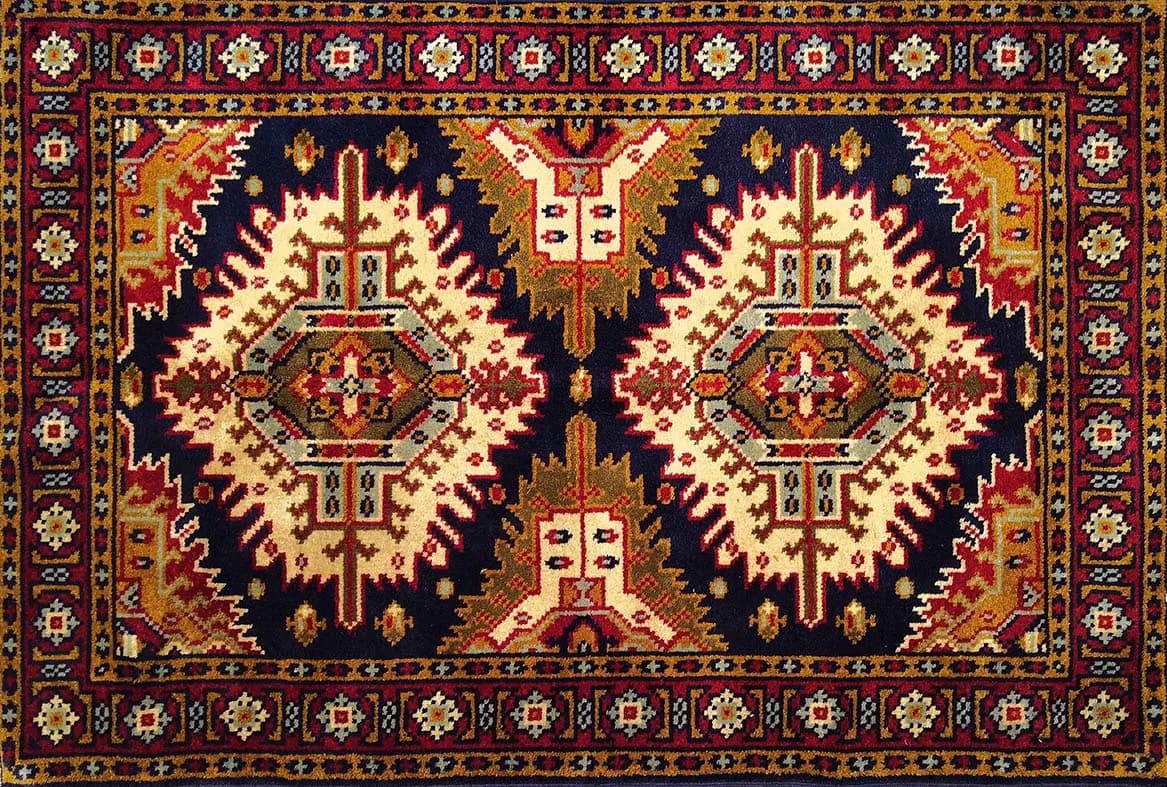
It is an entire text woven with threads, where every symbol, color, and ornament has its own story and hidden meaning. For centuries, Armenian women have "written" their emotions, beliefs, dreams, and their perception of the world around them onto these mobile frescoes.
This article is a guide that will help you "decipher" those secret codes and learn to "read" an Armenian carpet, discovering its mysterious world.
The Mystery of the Dragon: Guardian or Monster?
One of the most famous and powerful symbols in the art of Armenian carpet weaving is the dragon. In the ancient world, unlike in Christian interpretation, the dragon was not a symbol of evil. On the contrary, the dragon depicted on a Vishapagorg (Dragon Rug) was a powerful totemic creature, an embodiment of the forces of nature.
- Symbol of Water and Fertility: The dragon was the lord of the celestial waters—rain and thunderstorms. Its image on a carpet was meant to ensure an abundant harvest and fertility.
- A Protective Force: Thanks to its powerful appearance, the dragon was considered the guardian of the home and family from the evil eye and evil forces.
- Wisdom and Eternity: Dragons depicted in an S-shape often symbolized the continuity of life, rebirth, and eternity.
So, when you see a Dragon Rug, remember that you are not looking at a monster, but at the image of a powerful spirit of nature that has protected the Armenian hearth for centuries.
The Language of Colors: What the Threads Tell Us
The colors in Armenian carpets are not accidental. They were derived from natural dyes (plants, insects), and each had its own deep meaning.
- Red: Obtained from the legendary Vordan Karmir (Armenian cochineal insect). It is the most powerful color, symbolizing life, blood, passion, strength, and struggle.
- Blue: Derived from the indigo plant. It symbolizes the sky, faith, hope, divine wisdom, and eternity.
- Green: Symbolizes nature, spring, rebirth, and paradise. It was often used in depictions of the Tree of Life.
- Yellow/Orange: Symbolizes the sun, light, power, and divine might.
- Black/Brown: Symbolizes the earth, mourning, and the underworld. It was often used to emphasize the borders of the carpet.
Sacred and Secular: How to Differentiate the Carpet's "Theme"
Armenian carpets can be conditionally divided into two main groups based on their theme and purpose.
- Secular Carpets: These tell stories of daily life, nature, and pagan beliefs. They are dominated by images of animals (deer, goats, birds), hunting scenes, the Tree of Life, and geometric patterns (crosses, rhombuses, stars). Each pattern has its meaning; for example, the S-shaped symbol is a guardian against evil, and the Tree of Life is a symbol of the family's continuity.
- Sacred Carpets: The most famous type of these carpets are the Khoran or Altar/Prayer Rugs. They are easy to recognize by their main design: the image of an arch (khoran), which symbolizes the church altar or the gates of paradise. On these carpets, you can often see depictions of lamps, crosses, angels, and other Christian symbols. They were used to adorn church altars or for personal prayer.
A Journey Through Armenia: Weaving Styles by Region
Different historical regions of Armenia had their own unique carpet weaving styles, which differed in their ornaments, color combinations, and techniques.
- Artsakh: One of the richest and most diverse centers of Armenian carpet weaving. Carpets from Artsakh are characterized by medallions (large central patterns), especially the "artsvabazuk" (eagle-wing) ornament, which combines the symbols of the eagle and the sun. Dragon rugs are very common here.
- Syunik: The carpets of Syunik are known for their starkly geometric, large, and bold patterns. Here too, dragon, Tree of Life, and S-shaped motifs dominate. The colors are often bright and contrasting.
- Lori: Carpets from Lori are characterized by large, multi-colored cross-shaped medallions arranged in the central field. This style is known as "Lori-Pambak" and is distinguished by its stately appearance.
- Shirak: Carpets from the Shirak school are more restrained in their color schemes. They are characterized by vertical ornaments and arrangements in "belts" or stripes.
Every Armenian carpet is a cultural passport, bearing the stamp of its place of creation, its time, and the soul of its weaver. It is a silent storyteller that transmits the beliefs, the perception of beauty, and the harmony with the world of our ancestors to future generations. We hope this guide will help you to look at Armenian carpets with new eyes, seeing not only the skillful interweaving of threads but also the thousand-year-old stories hidden within them.
Related articles

 HistoryJanuary 7, 2026
Venezuela: The Tragic Phoenix of Latin America - From Oil Paradise to Geopolitical Nightmare
6 min read LifestyleDecember 9, 2025
Festive Tables Around the World: New Year's Traditions and Their Flavorful Nuances
9 min read LifestyleNovember 10, 2025
When Steel Starts to Think: China’s Robots Step Out of the Lab
10 min read HistoryOctober 27, 2025
How the €88 Million Heist Shook the Louvre and Awakened the Ghost of the Mona Lisa
12 min read HistoryOctober 18, 2025
The Gaza Conflict: How It Started, Why It Persists, and Where It Might Go
9 min read LifestyleOctober 10, 2025