
Levon V de Lusignan: The Last King Without a Kingdom
In the heart of Paris, within the pantheon of French monarchs at the Basilica of Saint-Denis, lies a tomb that always raises questions among visitors. It does not belong to a French king, but to a title that sounds like an echo from a lost history: "King of Armenia."
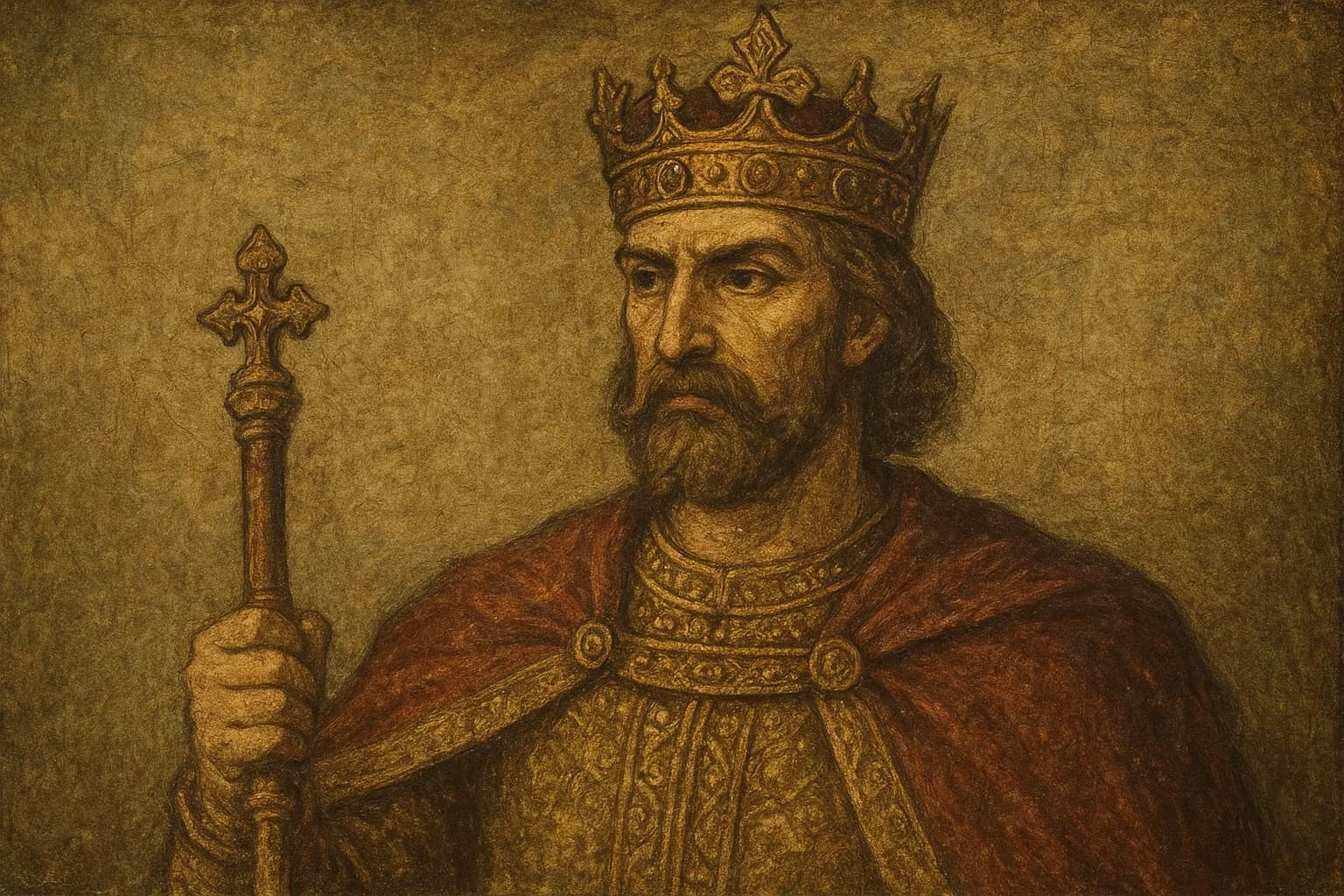
This is the final resting place of Levon V de Lusignan, the last ruler of the Armenian Kingdom of Cilicia - a man who lost his kingdom but never his royal title or his mission. His life is an unprecedented story of tragedy, adventure, and relentless struggle.
At the Center of the Storm: Ascension and Fall
When Levon de Lusignan arrived in the Cilician capital of Sis in 1374 to assume the throne, the Armenian kingdom was already a mere shadow of its former glory. Having served for centuries as a Christian island in a sea of Muslim powers, Cilicia was exhausted by endless wars. Levon's coronation took place in a city already under siege. The Mamluks of Egypt, who had long sought to put an end to Armenian statehood, had surrounded the last bastion of the kingdom with their full might.
However, the external enemy was not the only threat. The kingdom had long been fractured by internal discord. Levon, a Catholic of the French Lusignan dynasty, was ascending the throne of a country where the majority of the nobility and clergy adhered to the Armenian Apostolic Church. The noble houses were split into two factions: the pro-Latins, who were willing to make even doctrinal concessions to receive military aid from the West, and the nationalists, who were skeptical of Western promises and fought to preserve their national and religious identity. This internal division was a fatal blow to the weakened state, making it easy prey for the powerful military machine of the Egyptian Mamluks.
His reign lasted only a few months. In 1375, after a long and heroic resistance, Sis fell. Levon V, along with his family, was taken captive and led in chains to Cairo. This was not just the personal tragedy of one king; it was the end of independent Armenian statehood for nearly the next six centuries.
The Gilded Cage: Captivity in Cairo
In Cairo, Levon was no ordinary prisoner. He was a captive king—an important political pawn in the hands of the Mamluk Sultan. He was kept in honorable conditions but under strict surveillance. Levon spent seven long years in this "gilded cage." During that time, he lost his wife, Margaret of Soissons, and their only daughter, Mariam, which made his grief boundless. Yet, even in captivity, he never stopped thinking about reclaiming his lost kingdom.
Negotiations for his release began through the mediation of several European monarchs, especially King John I of Castile (Spain) and the Pope. After lengthy diplomatic efforts and the payment of a large ransom, Levon V was finally set free in 1382.
The Pilgrim King: Freedom and a New Mission
Freed from captivity, Levon began the second, no less dramatic, phase of his life. He was no longer a reigning monarch but a king-in-exile, whose sole purpose was to organize a new crusade to liberate Cilicia. He traveled from one European court to another, serving as a living symbol of a fallen Christian kingdom.
His first destination was Castile, where King John I received him with the highest honors. As a sign of respect and support, the Spanish monarch granted Levon lifelong lordship over the cities of Madrid, Villa Real, and Andújar, along with a generous annual pension. Levon V de Lusignan thus became the first and only foreign lord of Madrid. For him, however, these Spanish domains were merely a temporary station. His gaze was always fixed eastward, toward his lost homeland.
On the Grand Stage: The Peacemaker in the Hundred Years' War
Levon soon realized that his dream of a crusade would never materialize as long as Europe's two great Christian powers, England and France, were locked in the devastating Hundred Years' War. It was here that he took on an incredible role: that of a peace negotiator between the two rival kingdoms.
He believed that if he could reconcile King Richard II of England and King Charles VI of France, they would direct their united forces to the East to liberate not only Armenia but also other Christian holy sites. His diplomatic mission was not easy. Levon had to navigate complex political labyrinths where each court had its own interests and prejudices. He did not merely plead; he presented strategic arguments, emphasizing that the internal wars of Christendom only weakened the common front and strengthened external enemies. His status as the "last Christian king of the East" gave him a moral authority that allowed him to speak with European monarchs as an equal.
Using his diplomatic skills, Levon traveled between London and Paris for several years. He succeeded in arranging several meetings and even brokering short-term truces. The European monarchs listened to him with respect, but ultimately, their political interests proved stronger, and Levon's grand initiative - to reconcile the West for the sake of saving the East—eventually failed.
The Parisian Epilogue and a Royal Burial
Levon V spent the final years of his life in Paris under the patronage of the King of France. He died on November 29, 1393. In a sign of immense respect for his "brother," the King of Armenia, King Charles VI of France ordered that he be buried not in a common cemetery, but in the Basilica of Saint-Denis, alongside the kings of France. This was an unprecedented honor, testifying to the authority that the landless but unbreakable king commanded.
A moving epitaph in Latin is carved on his tombstone, summarizing his entire life:
"Here lies the most noble and excellent Prince, Leon de Lusignan V, the Latin King of the Kingdom of Armenia... who rendered his soul to God in Paris on the 29th day of November, in the year of Grace 1393."
The story of Levon V de Lusignan is a symbol of the resilience of the human spirit. He lost his throne, his family, and his homeland, but he fought until his last breath for the return of what was lost. His life demonstrates that being a king is not just about possessing territory, but about responsibility, mission, and an unbreakable faith. His tomb in Paris reminds the world to this day of the independent statehood of Armenia and of its last, indomitable king.
Related articles
 HistoryJanuary 7, 2026
Iran: From a Millennial Empire to the Strict Mandates of the Islamic Republic
5 min read HistoryJanuary 7, 2026
Venezuela: The Tragic Phoenix of Latin America - From Oil Paradise to Geopolitical Nightmare
6 min read LifestyleDecember 9, 2025
Festive Tables Around the World: New Year's Traditions and Their Flavorful Nuances
9 min read HistoryDecember 8, 2025
The Spitak Earthquake: History and Statistics of a Catastrophe (December 7, 1988)
7 min read HistoryNovember 17, 2025
The Horrifying but True Story of a 5-Year-Old Who Became a Mother
4 min read HistoryNovember 7, 2025